
My friend Dorthe and I are chatting away, strolling through the pedestrian shopping district of central Aarhus, Denmark on our way to a restaurant for dinner. Roger and Erland are walking together well ahead of us on the street, each leaning into the conversation, happily engrossed in what they’ve talked about for three days—the equations of their joint theory of supply chains or, alternatively, university politics. They are so obviously enjoying themselves, and I think, “This is what we’ve come for.”
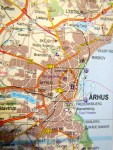
Aarhus, Denmark (correct spelling Arhus, with a little circle or band over the A) is our first stop on Roger’s sabbatical. Some years ago he was a conference participant in Salerno, Italy while I was, yes, the trailing spouse or, as they called it, “an accompanying person.” A delightful Danish lady was also in that category and while we queued in the broiling sun waiting for tour buses that were invariably an hour late, we buddied up and became friendly. Roger, meanwhile, connected with the only other conference participant who worked in the same kind of mathematical equations for supply chains and those two found themselves an empty room with a white board and spent happy, mad hours completing each other’s theories. Naturally, it turned out that the delightful Danish lady and the Danish professor who actually spoke the same language as Rog are a married couple. A friendship and working partnership was struck.
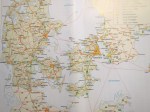
Aarhus is halfway up the eastern coast of Jutland, at about the same longitude as Edinburgh, Moscow, or Alberta. Settlement goes back over 1,000 years to at least 800. It is the second largest city in Denmark. It’s an immense container port, busy and prosperous. There’s a great building boom going on with massive glass and concrete modern office buildings and skyscrapers being erected near the harbor. Our friends disapprove. The traditional brick architecture of Aarhus is spacious enough and very traditionally attractive, with high windows and rooftop skylights. All buildings seem to want to let in more light. The sea is always nearby and the area is coastal, with only low, gently rolling hills relieving the beaches and flats. Very rural outside the city, lovely. The light this time of year is exquisite–long, clear, slanted sunlight illuminating the tilled fields, long white farmhouses, and forests of evergreen and birch. Late September is breezy and cool, but so crisp.
On our first afternoon our friends gave us a smorgasbord lunch at their house in the Risskov neighborhood, then we explored the beach right down their road on Aarhus Bay. In the distance we could see the cranes and ships of the harbor. By evening we four found our way to a French restaurant in an old section of Aarhus, in a tiny, gnarly building supposedly the oldest place in the city to house a restaurant. From the beginning, the conversation has been a feast in itself—politics, children, travel—but then books, films. And when am I just able to talk about language—how words work and change, the evolution, the structure, comparing and just figuring it all out? But Dorthe is a translator and for me this was a casual, constant thread through our weekend.
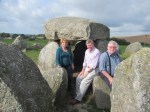
Our Sunday began with a trip out to Ebeltopf, a medieval town perched on the other side of the bay. We wound through the countryside, stopping to view a ruined castle on a coastal island. Then to the “Poskar Stenhaus,” a grave barrow estimated to be 5,000 years old. There are other barrows in the countryside, high anomalous hillocks that suddenly jut up from the landscape. But this is the last fully preserved “round barrow” in Denmark, a stone circle surrounding 4 upright megaliths and a capstone of 11.5 tons. Clearly, some extremely important stone age chieftain is buried there. After wandering Ebeltopf and having lunch, we toured the Jylland (which is Danish for Jutland), a frigate, the largest wooden ship in the world. And she is HUGE, 71 meters long with a 13 meter wide beam, a mighty and ferocious warship of the 19th century. She carried 44 cannon and a crew of 437. Today she is in dry dock, an interactive museum herself that we practically had to ourselves. Our day finished back in Risskov where Erland roasted lamb, Dorthe made a summer plum cake, and we continued the talk and eating and drinking.
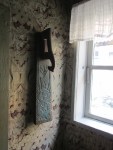
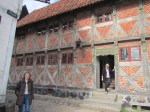
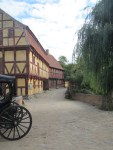
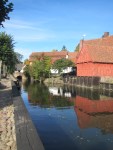
Monday was Roger’s day at Aarhus University, the Business School. He talked to faculty and dissertation students (apparently successfully), but the day was really about “drawing on the blackboard” with Erland, continuing their work and forgetting everything else. Dorthe and I spent a long, leisurely, excellent day at Den Gamle By (The Old City), a living history museum made up of a staggering collection of houses from all historical periods from c. 1700 to 1974, preserved and re-sited to this Aarhus park from all over Denmark. There are cobblestone streets and a millstream. Some houses are pure exhibition, some have costumed interpreters who stay in their historic period. But the most immersive part of the experience is that many period houses are so completely equipped and decorated and visitors can touch and handle objects and have the sense of being a little in the time. It was really well done. Even the restaurant food was traditional. It was most interesting to enter the 1960s and early 1970s—a time we both lived in and recalled sharply—because the environments were complete contexts. A bookshop from the late ‘60s where you could browse books, magazines, even comic books that were familiar from one’s own experience. A beauty salon, a grocery store with items and prices from that day. An extremely popular piece of history is the detail-perfect reproduction of a student commune from the early ‘70s. (Frankly, I found it too clean. I can’t imagine students in that time living so neatly!) But each apartment one entered was a completely immersive time capsule. You could open drawers and cupboards and handle personal effects. We gave ourselves the day—punctuated by pastries from the 18th century bakeshop that were baked to 18th century recipes and pancakes offered from the kitchen of the merchant’s house.
It was our last evening, spent having dinner in a famous “Barbeque” started by an Israeli immigrant 50 years ago and a hang-out for musicians and artists every since.
-

- On the beach at Risskov
-
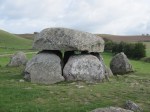
- Poskaer Stenhaus, a 5,000 year old barrow grave
-
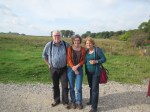
- Stopping at Kalo Slotsruin, the ruins of Kalo Castle
-
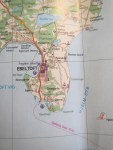
- Ebeltopf
-

- Walking the medieval town, almost deserted
-
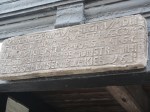
- early 17th century lintel
-
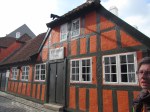
- The home of the “Faber,” the dyer.
-
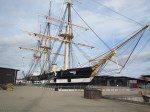
- The Jylland, launched in the 1820s and still the largest wooden frigate in the world
-
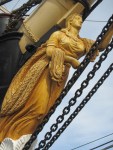
- The figurehead is the Norse sea goddess Ran, who catches the souls of drowned seamen in her net.
-

- The interactive, moving simulation of the 1834 Battle of Heligoland. During this battle, sailors consumed 577 litres of beer and 48 litres of spirits! And still won.
-
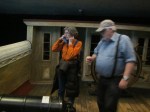
- Erland fires the cannon in the simulation. Dorthe responds.
-

- Dorthe on the top deck.
-
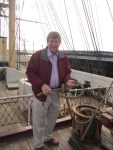
- Roger showing off his knot skills.

-
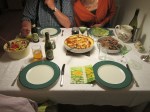
- home to a wonderful dinner
-

- Aarhus City Hall
-
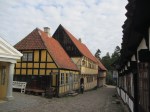
- Entering Den Gamle By, an outdoor museum of historic houses from all over Denmark

-

- The bakery runs as though it was still 1780 and the results are still delicious.
-
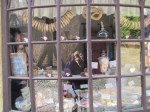
- Through the bakery window
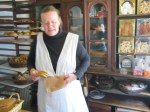
-

- The house of the Master of the Mint, a grand Baroque and Roccoco house in great contrast to other exhibits.
-
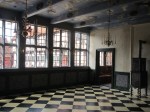
- elegant bright interiors
-
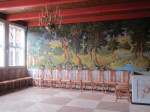
- fashionable decor
-
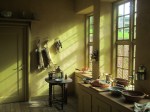
- the kitchen. The light is real.
-
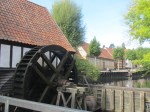
- The mill and the millstream
-

- The merchant (he’s real, too)
-
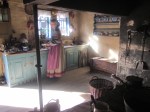
- We happened into the kitchen while the cooks were making pancakes stuffed with strawberry preserves.
-
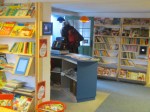
- The bookstore, vintage 1967, quite a memory.
-

- Central Aarhus
-
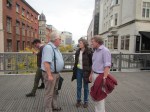
- Erland, Dorthe, Roger
-

- a central square in Aarhus
-
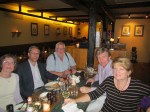
- dinner with colleagues and good friends
Sorry, my patient friends, that getting up a second blog has taken this long. We have been travelling. Now, however, we are based with Roger’s brother and our sister-in-law in Surrey (and have reliable wi-fi for a bit!).
 lettersfromatlantis