
This morning we woke to frost. The lawn of my sister-in-law’s garden is silvered. The windows of the greenhouse are patterned with whorls of white. The heat in the house is on and true autumn has arrived. For the past two weeks (call it a fortnight) the south of England has enjoyed a beautifully warm and sunny Indian summer (a term borrowed from us). Everyone has worn tee-shirts and shorts at home and I’ve wondered when I would break out all the warmer clothes we packed.
So, I begin in England discussing the weather. This is right, since that’s what everyone does, to almost a comical degree if you’re not British yourself.
We are based at Cranleigh, a post-card pretty village in Surrey, where Roger’s brother and his wife live, their children (our niece and her husband, our nephew, his wife and his daughter) have come back to live, and in an area close to Roger’s parents and one of his sisters and her family. Without the great kindness of Russel and Christine to offer us this long stay in their house, we couldn’t have pulled off this sabbatical. As it is, everything is so comfortable and familiar.
I realized, walking around the village a day or two ago, that I’ve been coming here for almost 35 years and have never written about it. I suppose it doesn’t seem part of the touristy routine and I take it for granted. But Cranleigh is a bit special.
It’s an old village. There was settlement here at least as far back at 1086, the time of the Domesday Book, although it was part of Shere manor then. The church, St. Nicholas, goes back to 1170. The present classic Anglican building was built in the mid-1400s and extensively restored in 1847. In 1657 Oliver Cromwell quartered his troops in one of the buildings still on the High Street (now a restaurant with good food and slow service). The village is surrounded by countryside. Beautiful, patchwork fields and farms with horses and sheep, and the dense remnants of a very old forest called the Weald (the roads are very narrow and twisty). But it’s also close to towns like Guildford and Horsham, so it’s convenient to the railways and to London. All this makes it a very attractive bedroom community to the City as well as a stand-alone village. On the outskirts are estates of rock stars like Ringo Starr and Eric Clapton. There is, of course, a cricket club (1843) with well-kept pitch and a nice clubhouse. Roger celebrated his 50th birthday there (a few years ago!) partnering with his brother, and they won.
Cranleigh styles itself the largest village in England. Population a bit over 11,000, but the claim to size has more to do with the sprawl of neighborhoods that spread out from the central high street. The place has a strong sense of its own identity and hasn’t succumbed to big box stores and national chains. There is a Sainsburys and an M&S food, but there’s also a local fishmonger, an ironmonger, a good butcher, a nice bakery. Sadly, the bookstore has gone since my last long stay. There’s one of those small family department stores (remember Leys’?) that goes back to the late 1880s and has managed to keep up and survive. There’s always interesting stuff in Mann’s.
Roger, during this period of the sabbatical, has been commuting back and forth from Cranleigh to the University of Sussex in Brighton, a little over an hour away. He complains—isn’t that a Rhode Islander for you? Sussex is Rog’s undergraduate alma mater, so there’s a little nostalgia and pride mixed in with the business of meetings and talks he’s there for. I’ve been asked to talk with their development office on Tuesday about university fund-raising in America.
Staying here, we see family. We visit Roger’s parents in the village of Warnham. I get to meet up for coffee with my niece, Gemma, here is Cranleigh. Sunday Gemma and her husband Jon, and Roger’s sister Gillian and her husband Dominic all came for dinner with Russ, Chris, and us. Being able to combine his working sabbatical with a long visit to his family is exceptional for Rog—likewise myself.
-
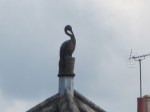
- Cranleigh is thought to mean “the open place in the forest where the cranes gather.” The crane is certainly the symbol of the village.
-
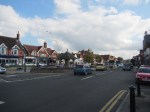
- The High Street
-
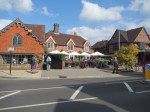
- Oliver Cromwell’s troops were quartered here.
-
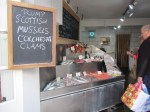
- The fishmonger’s
-
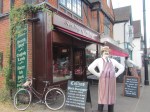
- The butcher’s
-
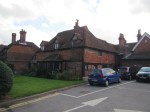
- The hospital dates to early Victorian times
-
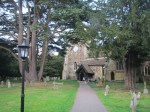
- St. Nicholas’ church and the ancient churchyard
-

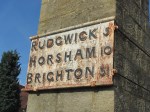
- The mileage marker
-
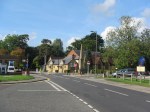
- This is where you enter the village
-
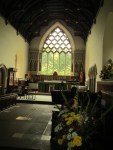
- interior of St. Nicholas
-
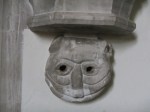
- This gargoyle of a cat has always been thought to have inspired Lewis Carroll to create the Cheshire Cat in Alice in Wonderland. Sadly, he had already written the book before he visited this church. The coincidence makes a good story, though.
-
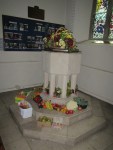
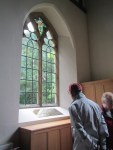
- Harvest Home this weekend. Here the baptismal font is decorated with fruits of the harvest.
-
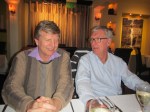
- Rog and Russ at the Indian
-
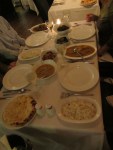
- Wonderful Indian meal of various lamb curries and (mine) excellent duck in coconut milk sauce.
-
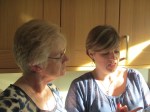
- Chris and Gemma
-
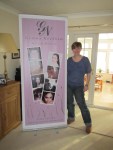
- Gemma, our niece, has launched her own business in beauty and special event make-up.
-
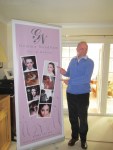
- Her uncle Dominic designed the poster for her bridal fair appointments.
-
- Gemma and Jon
-
- Me with my sister-in-law Gilly
-
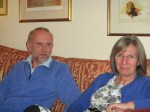
- Gill and Dominic
-
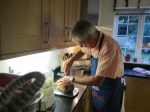
- Russ carving a lovely roast of lamb.
-
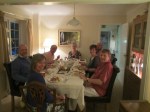
- Family at dinner
-
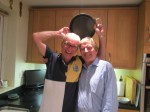
- Silly brothers cleaning up
 lettersfromatlantis