
Remember how in high school history class or in some English history class in college we learned about the guilds of the middle ages? You know, how the merchants and tradesmen of the growing cities gathered into associations where they regulated their industry, trained their apprentices, guaranteed the quality of what they manufactured, fixed prices, and excluded independent operators? You know, like the Bakers’ Guild, the Goldsmiths’ Guild, the Drapers’ Guild, or the Vinters Guild? These guilds came into England after the Norman Conquest (1066) and grew into a system called mercantilism. Guilds and their members became active, even dominant, in civic life and local politics. It was the guilds that sponsored the mystery plays of the middle ages. Chaucer mentions guild masters in The Canterbury Tales. They are this major feature of the rise of capitalism, too.
So, what happened to them? I bet you thought they disappeared. Not so, at least not in London.
The guilds, some of which go back to the 1100s, morphed and evolved into the livery companies of the City of London, of which there are 110 still operating today. Almost all of them are named “The Worshipful Company of . . .” and then the title of the trade, craft, or profession. Today they are elective fellowships that are charities and educational institutions as well as serious professional networking organizations. Nonetheless, they still revel in the ancient courtly traditions that stretch back centuries, observe their own peculiar protocols, and enact the grand and the majestic as only the British can do. A member, first beginning as a “freeman” who then becomes a “liveryman,” has certain ancient privileges. Some are funny today. For example, if sentenced to hang, a freeman is allowed a noose made of a silk rope. Freemen can drive sheep across London Bridge without paying a tax. But the liverymen also elect the Lord Mayor of London and have other official responsibilities in the City and to London. http://www.cityoflondon.gov.uk/about-the-city/working-with-and-for-others/Pages/city-livery-companies.aspx
Each one of the original guilds had a guildhall that, since the guilds became extremely rich, were fabulously, elegantly decorated. Most of them were destroyed in the Great Fire of 1666. Most of those that survived or were rebuilt were hit during the Blitz of World War II. And yet, there are survivors, most dating to the early 1700s and still reflecting the glories and wealth of those guild associations.
Last night Roger and I were honored and keenly delighted to be guests at the Installation Dinner of the Worshipful Company of Fuellers, held in gorgeous Skinner Hall (the Guildhall of the Worshipful Company of Skinners, rebuilt in 1670 after the Fire). http://www.skinnershall.com/welcome.html
Roger’s brother, Russel, is a Fueller. Indeed, he is a Court Assistant, meaning he’s on what’s like a Board of Directors. http://www.fuellers.co.uk The Fuellers trace their roots back to 1376 or earlier to the Coal Sellers, the association that later would handle the coal taxes that financed the rebuilding of the City of London after the Great Fire. So today their interests are across the board throughout the energy industries from coal and gas to renewable, green resources. They have a charitable trust fund, sponsor a school, do scholarships and lectures, support an air ambulance, and have affiliations with the Air Force and the Navy.
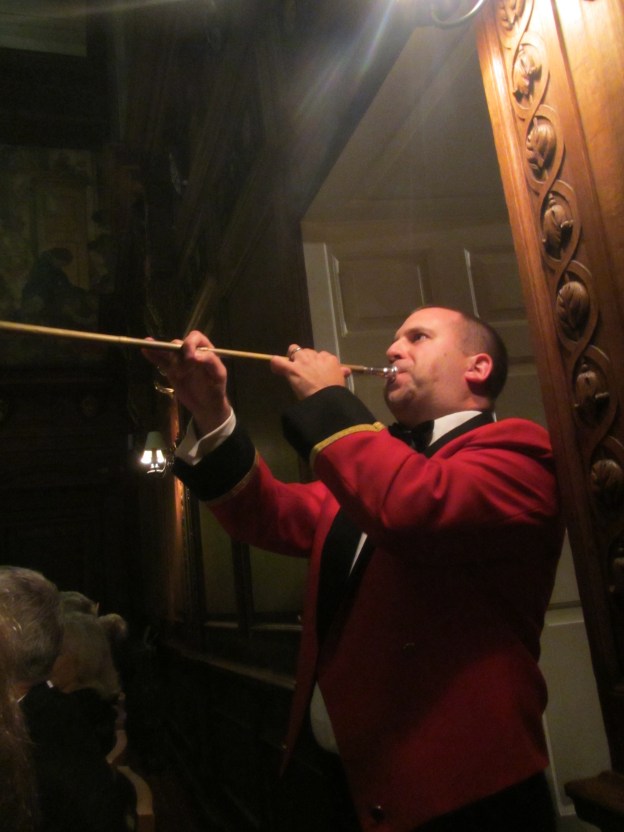
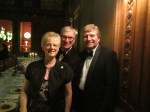
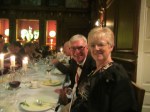
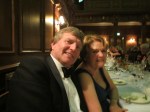
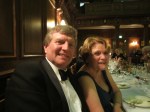
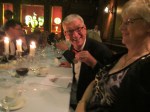
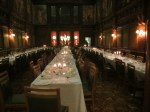
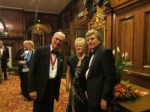
But, when they throw a banquet, it is all about the party! The Installation is the occasion when the new Master takes up his position. Men turned out in tuxes, swagged with ribbons and medals, women in gowns and jewelry. The Master and Wardens were gowned and hatted. In stentorian tones, we were announced for the receiving line by a gowned Beadle. We were summoned to dinner by a quartet of heralds playing post horns. Later, they played a show-off horn competition that was amazing! The four course delicious dinner was served in a sumptuous dining hall paneled with walnut and gleaming with candlelight and silver. An orchestra played from the hidden balcony (Hmmm. Do you think they’re playing “Home on the Range” for us?). There were some mercifully short speeches and many toasts. We toasted the Queen, the Royal Family, the Lord Mayor of London, the Distinguished Guests, and goodness-knows-who-else. There was even a Loving Cup toast with old traditions that was passed guest to guest around the hall.
Think, 150 people acting out Downton Abbey! One has to do it at least once.
-
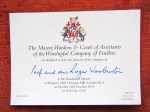
- Our confirmation notice from the Worshipful Company of Fuellers
-
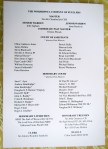
- Are they called “courtiers”?
-
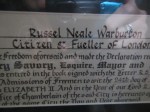
- My brother-in-law is legally granted “the freedom of the city”
-
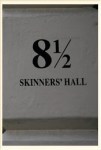
- This tiny door, numbered 8 1/2 opens off the street into the grandeur of the Hall. A bit like Platform 9 1/2 in Harry Potter.
-
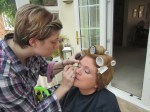
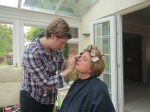
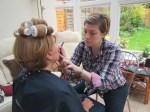
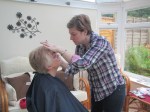
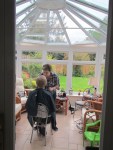
- My niece Gemma Needham, proprietor of her own business in make-up and hair styling, came over to do us up right!
-
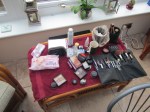
- Gem’s gear
-
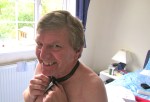
- Roger practicing tying his bow tie for his tux.
-
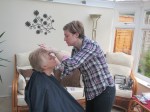
- Gemma made up her mother, Christine, after me
-
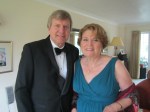
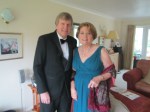
- Ready for the evening

-
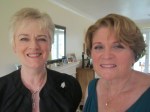
- Not bad for a couple of old broads
-
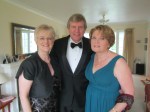
- Christine, Roger, and Eileen–all Warburtons
-
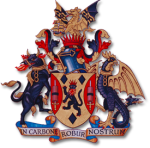
- The Fuellers heraldry shield: coal black dragons supporting a colliery cart. “Our faith is in carbon.”
-
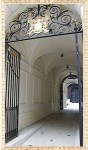
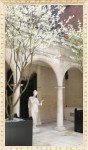
- The entrance, lifted from the website
-
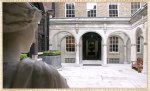
- photos lifted from the website, that I didn’t dare to take


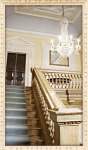
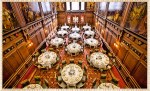
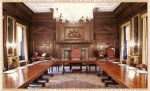
-
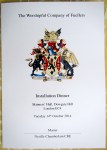
- The evening’s program
-
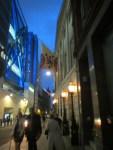
- arriving at Dowgate Hill, in the City of London

-
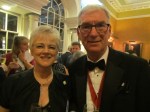
- Christine and Russel
-
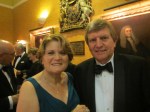
- us
-
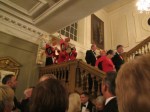
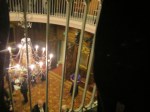
- Summons to dinner from the grand staircase
-
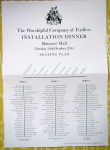
- the order of seating
-
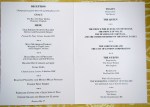
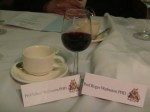
- the menu!
-
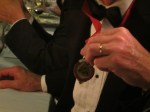
- Russel showing off his livery medal
-
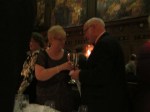
- The Loving Cup toast
-
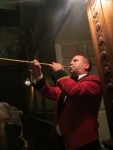
- The heralds trying to outdo each other. They were so impressive!
-
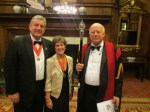
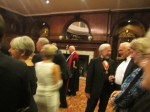
- The very first “lady warden” in the history of the company. In three years she will be Master. With her, her husband, and the Beadle.
-
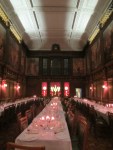
- The Dining Hall emptied after dinner
-
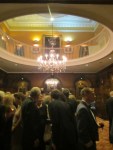
- The stirrup cup. It’s like “one for the road.”

 lettersfromatlantis