
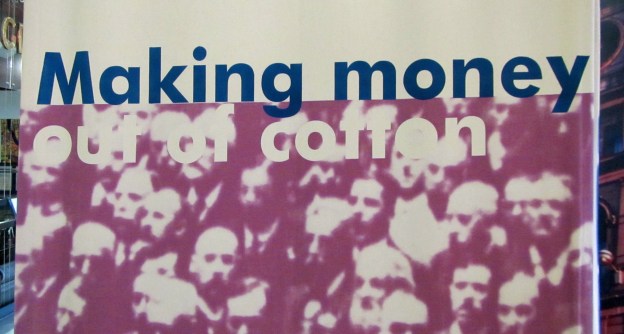
“Well, we’ve come this far. Might as well go the rest of the way.”
I am climbing up the steep stone steps to Clitheroe Castle, the highest point for many miles. It is pitch dark. It is pouring with rain. It is blowing a gale. This is an episode in this odd weather, where it will be clear for a while, mild and pleasant. Then suddenly a band of drenching rain will begin abruptly, blown in on a sharp blast of wind. Intense downpour for maybe 10 minutes, then it will stop and, once again, everything is fine and peaceful. When we started our climb, it wasn’t raining. By the time we arrive at the top, at the keep, the rain is blinding. But it is a triumphant and certainly interesting way to begin our stay in the market village of Clitheroe in Lancastershire where we are visiting Steve and Katherine. This castle is very old and is one of the smallest motte and bailey castles I’ve ever seen. But it was the seat of the Lords of Bowland until 1649. This was the first year of the Interregnum (right after they beheaded Charles I) and Parliament (in charge) went around putting potential anti-government defensive structures out of business. At Clitheroe Castle, they punched a huge hole right into the side of the keep,” to be put in such a condition that it might be neither a charge to the Commonwealth to keep it, nor a danger to be kept against them.”
Wet as we are, there is, fortunately, a warm, excellent restaurant close by that’s also on this evening’s agenda. Pico, the owner, always remembers Roger when he visits, and always gives Katherine and Steven special treatment.
Clitheroe is tiny, a very old market town in the Ribble Valley chartered in 1263, but older than that. Roger has been working with Steve for about 15 or 10 years supporting a revived British textile industry (think applications like medical supplies and aeronautics) and they had a very full week ahead.
I took myself off by train to explore Manchester.
Manchester was a challenge to me. I had been under the assumption that this industrial giant of the late 19th century was a derelict Rust Belt kind of city, dirty, drab, impoverished. Nothing could be further from the truth. I realize that I was carrying around a load of assumptions about northern English cities based on some clichés of the 1970s and ‘80s. (American inner cities weren’t doing so great in those days either). I was disabused of these wrong-headed notions by a development colleague at Sussex University with whom I spent some time a few weeks ago. She urged me to visit it while I was in the area.
So, braving high winds and intermittent downpours, I gave myself a speedy one-day tour of Manchester (population just under 600,000): Manchester Art Gallery, Manchester Town Hall, Royal Exchange Theatre, Museum of Science and Industry, plus some long walks down elegant, prosperous shopping and business streets lined with a distinctive 19th century redbrick, neo-Gothic architecture and punctuated with very modern skyscrapers. There is an energy there, and a sophistication. It doesn’t feel like a regional town or some poor relation of London.
Manchester was ground zero of the Industrial Revolution. Everything modern happened here first. Not only the first and (eventually mightiest) textile mills and all the innovations to that industry from the mid-18th century on, but all the accompanying infrastructure was invented here: the first passenger train, the idea of warehouses, the expansion into heavy machinery and chemicals. The industrialists dug canals all the way to the coast (36 miles!) to bring in coal and to ship out their goods. Even today they are expanding these canals. Manchester was once the third largest container port in Britain despite being 40 miles inland.
The city has a reputation for being radical. As the first truly industrialized city in the world, they were first to grapple with enormous extremes of wealth, an exploding population, slums, industrial pollution, sanitation issues, etc. The industrialists of Manchester were monster capitalists, but that very reservoir of wealth also produces its own backlash. There were bread riots, labor riots, the Peterborough Massacre of 1819, and the first Trades Union Congress. Fredrich Engles wrote The Condition of the Working Class in England in 1844 about Manchester, and Marx and Engels started writing the Communist Manifesto here in the world’s oldest public library (Chethams’s 1653). Woman suffrage was born here (the Pankhursts were local gals)! It was the cradle of the Labour Party. There were schools and universities founded by religious Dissenters (Quakers, Unitarians). As you might expect, they fostered technology and invention, so the sciences absolutely flourished in Manchester: the atom was first split here, the electron microscope was pioneered here, and the first stored-program computer was created here. Today, apparently, there’s a disproportionate LGBT population, so radical liberalism continues. What was interesting to me—granted, on only a few hours acquaintance—was the sense that the city’s identity derived from technological achievement (and the wealth from that) not, as often the case elsewhere in Britain, from the old hierarchy of landed aristocracy. This isn’t a new observation, of course, but it was a palpable feeling for me. I decided that I need to reread Elizabeth Gaskell’s novels.
When I go to a city that had a heyday of huge wealth and industry, I like to visit the art museum to see what the local rich people were collecting at that time. It tells you a lot (I think) about their aspirations at that moment. (Think of the Met in New York and all those Old Masters from personal collections, of Chicago and all those Impressionists in the Art Institute.) So in Manchester’s smallish, but quite fine, Art Gallery the largest part of the collection is Pre-Raphaelite! These were, of course, the most radical painters of the mid-19th century in England. They thought of themselves as revolutionary and, interestingly, as taking a stand against all the mechanization and conventionality of the modern (that is, 19th century) world—everything that Manchester stood for. The Pre-Raphaelite Brotherhood were for medieval art, romantic realism and the detail of Nature, ancient English legends, objects and furniture that were handmade and craft-produced. Just a complete backlash against the factory culture that was producing all the money of Manchester (which was, among other things, buying art). I was tickled to find that the wonderful sequence of a dozen big murals in the Great Hall of the Manchester Town Hall (depicting the history of Manchester) were all done by Ford Madox Brown, who was Dante Gabriel Rosetti’s teacher and friend, a PRB precursor and a founding member of William Morris’ design company. There are some satirical elements in several of them—like the one about John Kay inventing the flying shuttle (which revolutionized weaving) has a crowd of rioting Luddites crashing through the window while Kay is being spirited out the back door wrapped in a blanket.
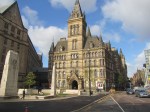
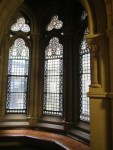
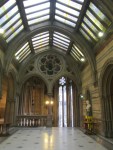
I got in to see those murals and the rest of the visitor-restricted part of Town Hall by coming on politely with wide-eyed enthusiasm and my American accent. I find this often works. So I was able to roam the mayor’s parlor, the committee rooms, the Great Hall, the grand staircase, etc. under a legitimate visitor’s pass. Manchester Town Hall is a very grand Gothic Revival complex from 1877. It’s all very elaborate late Victorian and ceremonial, but the statues and paintings all celebrate local scientists and this technological history I’ve been talking about.
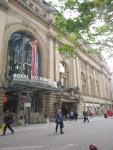
Most fascinating stop of the day was the Royal Exchange building. It’s the third exchange built since 1729, because trade grew at such a rate that they kept having to build bigger. This one, which opened for trade in 1874, was at that time the largest trading hall in the world and one of the largest rooms in the world, too. It’s this neo-classical shrine, a marble temple to money, very grand and gorgeous. The exchange took a direct hit in the Blitz and limped along until it closed for good in 1968. It was scheduled to be razed when a bunch of theatre folks took it on, founding the Royal Exchange Theatre and rescuing the historic space. The first Artistic Directors were Michael Elliott, Caspar Wrede, Richard Negri, James Maxwell, and Braham Murray. Lawrence Olivier opened the house in 1976.
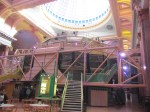
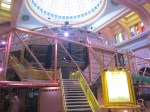
If ever there was a fabulous and emotional pitch to be made for all of us Rhode Islanders voting this November for Proposition 5 to help subsidize the restoration of our arts and performance spaces, a visit to this theatre is definitely IT. It’s a mind-blowing adaptive reuse. The house and in-the-round stage itself sits like a space craft that’s landed in the middle of the vast neo-classical room. Actually the floor of the old building can’t bear the weight of the theatre, so everything but the actual stage is suspended from the huge columns carrying the central dome of the building. There’s a 700-seat capacity possible on 3 levels—the largest in-the-round in Britain. They’ve also developed a 90-seat flexible black box in an antechamber. The Royal Exchange Theatre presents nine full productions a year, plus a holiday show, folk, jazz, and rock concerts, literary events, and a full roster of kids’ stuff. When I visited they were breaking down an all-female Hamlet and doing tech for Cat on a Hot Tin Roof. In 1996 the Exchange building was one of those severely damaged by an IRA bomb, just as they were about to open Stanley Houghton’s Hindle Wakes. Two years later, after refurbishment and an opening by Prince Edward, they opened with that play.
My afternoon was capped by meeting up with Roger and Steve after their successful mini-conference. Steve drove us out to Quarry Bank at Styal, a preserved and interpreted textile mill run by the National Trust. Established by Samuel Greg in 1784, QB was one of the earliest mills and ran right up to 1959. Like our Slater Mill (and you know that Sam Slater started by copying Arkwright plans from Manchester, bringing them to Pawtucket with Brown financing in 1790), there are well-informed interpreters who run and demonstrate the massive machinery and good exhibitions explaining the long, complex economic and social history. We had our own expert interpreter in Steve, who began his career in textiles as a certified weaver and could clearly explain all sorts of little facets of how these machines had evolved and worked. High winds had forced early closings to several buildings in the mill complex—but this may have been a good thing. There was so much to see, we’d still be there.
-

- Back on the motorway, headed for the north.
-

- In Lancastershire, autumn is much further along.
-

- Coming into Clitheroe
-
- The keep of Clitheroe Castle in a downpour
-

- This hole was blown through the side of the keep by Parliament in 1649.
-
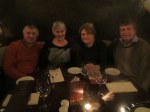
- Dining at the Villa: Steve, Katherine, Eileen, and Roger
-
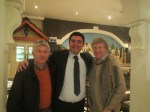
- Steve and Roger with Pico, the owner
-
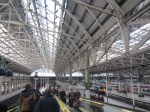
- Welcome to Manchester, the Manchester-Picadilly railway station
-
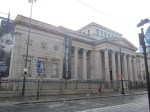
- Manchester Art Gallery
-
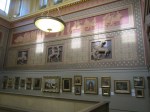
- central hall of the Art Gallery with friezes by Wedgewood and a few fine 20th century paintings.
-
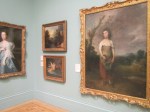
- The Gainsboroughs
-

- A nice Joshua Reynolds
-
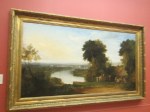
- An extremely early Turner
-
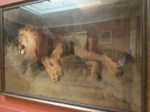
- a Landseer, of course
-
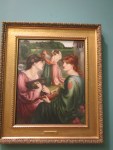
- Then lots of Pre-Raphaelites, easy to identify–this is Rosetti
-
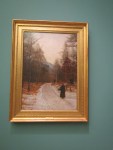
- early Milais
-

- later Milais
-
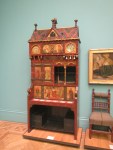
- Pre-Raphaelite furniture ideas
-
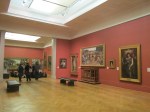
- One of the many Pre-Raphaelite galleries.
-
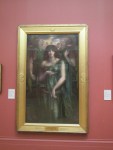
- One of Rosetti’s seductive temptresses
-
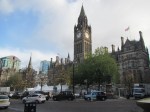
- Manchester Town Hall, a great example of Gothic Revival
-
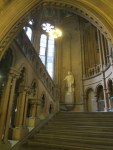
- Manchester Town Hall, Grand Staircase
-
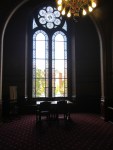
- Committee room
-
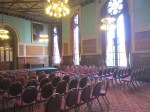
- The Lord Mayor’s Parlor
-
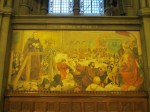
- Mural by Ford Madox Brown, The Defense of Wycliff. The man gesturing in Wycliff’s defense is John of Guant. The one whispering in the King’s ear is Geoffrey Chaucer.
-
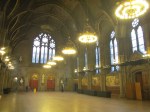
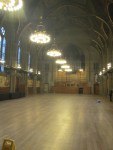
- Grand Hall of Manchester Town Hall, lined by 12 murals depicting the history of Manchester
-
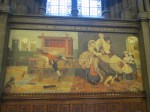
- John Kay, inventor of the flying shuttle. Note the hand weavers (put out of work by mechanization) to the left as they burst through the window. Kay escapes out the back door.
-
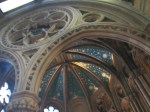
- ceiling of the Grand Staircase
-
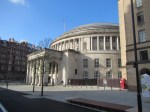
- Central Library, attached by bridges to Manchester Town Hall
-
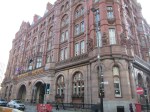
- Typical of Manchester’s 19th century architecture
-
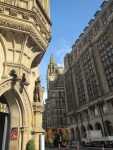
- Typical street view
-
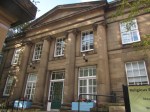
- Meeting house of the Society of Friends, the Quakers

-
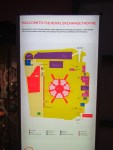
- Design of the stages of the Royal Exchange Theatre.
-
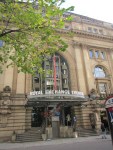
- The Royal Exchange Theatre facade
-
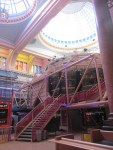
- The Royal Exchange Theatre, main stage enclosed in the original exchange chamber.
-
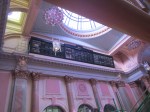
- The stock market board across from the theatre
-

- Dressing the set for Cat on a Hot Tin Roof
-

- What’s playing
-

- This season’s offerings
-

- Hamlet, an all-female version
-

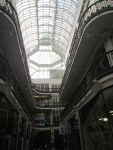
- Victorian arcades tucked away on lanes between modern shops
-
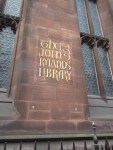
- More private libraries than I’ve ever seen in a city
-
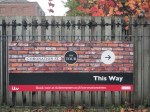
- The ever-popular Coronation Street has always been produced and shot here
-
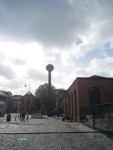
- The Museum of Industry and Science in the original railway warehouse
-
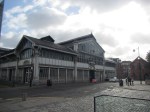
- More museum in a great market building.
-

- MOSI inside
-
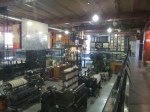
- exhibits of cotton manufacturing
-
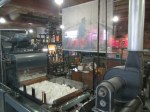
- the carding machines
-
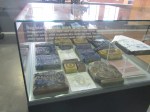
- originals trade marks
-
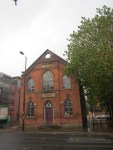
- The schoolhouse built for children textile workers.
-
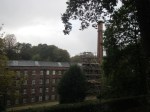
- Quarry Bank at Styal, one of the oldest mills (1784 – 1959), preserved as a site museum by the National Trust.
-

- Roger and Steve walking through the rain to visit the mill.
-
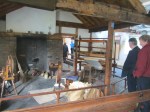
- Steve and Roger. What hand-spinning and weaving looked like before the machinery and the mill system.
-
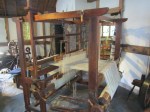
- Hand loom
-
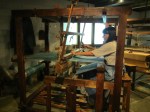
- One of the guides demonstrating the loom. At one point she said to Steve, “Oh dear, I think you know a lot about this, don’t you?”
-
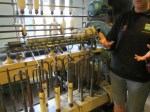
- Loud, fast, terrifying machines to stretch, twist, and spin the cotton.
-
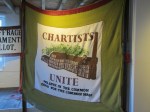
- Political activism grew among the mill workers.

-
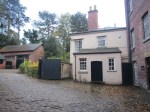
- mill buldings
-
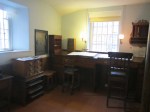
- counting house
-
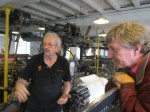
- One of the weavers answering Roger’s questions.
-

- As you get closer to the source of power, the enormous water wheel, the sound gets louder and louder, pounding and swooshing.
-
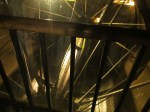
- The wheel. Huge, powerful, and even beautiful.
-

- Back on the motorway to the north
 lettersfromatlantis