
[This will appear out of order, since something technological went awry. It’s supposed to be the penultimate post of this section. However . . . ]
——————————————–
“Omigod!,” exclaims Roger. I have NO idea where I am!” We are driving at night, up the A48 into Cardiff, Wales. This should mean that we are on the Newport Road into town, passing familiar houses, the turn-off to Roger’s high school, an overpass with a beer advertisement, etc. Instead we are surrounded on all sides by neon-lit shopping malls, block after block. It’s stunning. It’s kind of American. It’s entirely unfamiliar.
But a few more blocks and we’re back among the 19th century row houses (terraced houses, here) and it looks as we remember it. The shopping malls, the expansion, the sense of commercial development, however, are all marks of the new Cardiff. Like me going back into Washington, D.C. and invariably getting lost, Roger can barely recognize his hometown and it’s only been a very few years since we were here.
Cardiff has emerged from its post-industrial torpor. It was once a smokestack city with booming docks along the Bristol Channel, a mighty port city shipping coal from the Welsh valleys out to power the world. After the war, as the mines closed one by one, Cardiff slumped into a kind of obsolesce, still cultured and proud, but its elegance a bit shabby. When I first knew it in 1970 and long after, it felt like such a regional backwater and so old-fashioned.
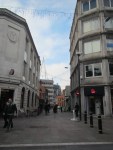
The city has reawakened. It has changed, but kept its soul. Rog observes that it’s a good example of what can happen to a city when government and citizenry invest in infrastructure. The bay area has been redeveloped with museums, houses, shops, and the very beautiful and very “green” Welsh Assembly (the capital of the national government). The River Taff—formerly ink-black with coal run-off—now runs clean. The older buildings, like the gorgeous Civic Center complex, have been cleaned while they sit shoulder to shoulder with architecturally innovative modern skyscrapers. New hotels, new restaurants. The university expanding. Beautiful and futuristic, the Millennium Stadium is right in the city, visible from all over, third largest in Europe (a capacity of nearly 75,000). The downtown shopping district spreading out from Queen Street and well up to Cardiff Castle is entirely pedestrian now, filled with people, bright with upscale shops, the best department stores, and little boutiques. The big city market and the arcades are still there, along with the churches, and newly-developed parks and outdoor space for sitting or meeting up.
Roger can recall in the 1960s when Queen Street was the first to be recreated as a pedestrian street. His father was a City Councilor then and brought home the architectural plans of the proposed urban changes. The proposal caused huge controversy and many people were against the notion, but it was in fact very forward-thinking. Today, the complex of pedestrianized streets in the center of the city is such a welcoming, commercially successful, people-friendly space. I dragged Roger out to a pub after a tiring day he spent working at the university and he was astonished walking down the middle of the High Street into St. John’s at the life in the streets and in businesses.
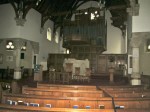
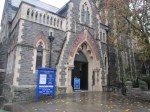
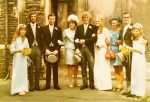
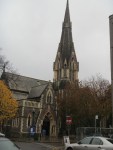
My sister-in-law Hazel and her two boys, Patrick and Eliot, now live in Cardiff. My thought, as we ate dinner with them early in this week, was that they are making a life in a place that has exciting possibilities and new cultural energy. It’s very positive. While Roger has worked and lectured at Cardiff University this week, I’ve reacquainted myself with this new/old Cardiff. I toured Cardiff Castle, wandered the streets, shopped. Most important for me, as it turned out, was coming upon Windsor Place off of Queen Street and discovering the church where I was married in August 1970.
In those days it was a Presbyterian church and the minister was Mr. Norman Birnie, the father of one of Roger’s dearest childhood friends, Alasdair. It was Mr. Birnie who would marry us and then (with his wife, Felicite) become a dear friend for the rest of their lives. He was a compassionate and progressive man—to the point where he was highly criticized by some parishioners for performing a wedding ceremony for two people who had been divorced. So, anyway, I like to think that he would be as pleased as I was to discover that Windsor Place Presbyterian had transformed into the City United Reformed Church—its motto: “Open Hearts and Open Minds.” It’s a place of progressive active outreach to all populations that celebrates diversity and reconciliation. I’m told that during the city’s Gay Pride Parade, the church was the rallying point.
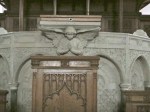
The place was humming with people, but the sanctuary was dim and empty, so I thought I’d look in. I didn’t expect to feel such emotion there as I did. I felt like someone punched me in the chest. It wasn’t that I felt sentimental or romantic about my wedding. It was more that I suddenly was aware of so many losses and the passage of time. I didn’t think about Roger too much, I guess because I still have him. But I was powerfully aware of losing my parents, thinking of them so young and so happy on my wedding day. Alasdair, too, is gone, as are Norman and Felicite Birnie, his parents. Roger’s grandmother and aunts. Roger’s mum and dad, who were still in their forties on that day, are now aged. The family who gathered, the few friends who could make it—we have all come to the last years of our careers. We have grown children. All this felt very concentrated as I sat in that room.
Cardiff has become even more a family magnet since Roger’s sister Hazel and her youngest, Eliot, have moved back here. Her eldest, Patrick, has made his home in Cardiff since he finished university here. Our dear friends, Gareth and Liz, live “up the valleys” in the village of Maesycwmmer. Gareth and Roger go back to childhood, to days as choirboys at St. James’ and their afternoons at the matches at the Arms Park. So, while Rog commutes to the University of Cardiff for a few days, I am happily among friends.
-
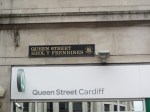
- Strolling Cardiff, the queen Street pedestrian mall
-
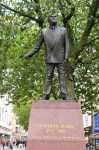
- Aneurin Bevan, the great Welsh socialist leader and silver-tongued orator
-
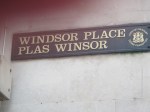
- Finding myself on familiar ground.
-
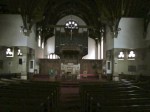
- The sanctuary is the same.
-
- The altar hasn’t changed.
-
- The City United Reform Church 2014
-
- August 1970, same spot
-
- The old central library is now a museum.
-

- The new central library
-
- Once the best local shop, the Howells building survives, now the national shop House of Fraser. I bought my wedding dress here.
-
- The stadium glimpsed down the streets
-

- City Hall and the Museum
-
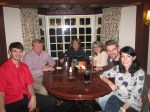
- Dining out with family: Eliot, Roger, me, Hazel, Patrick, Lisa
-

- My sister-in-law Hazel with her two boys, Eliot and Patrick
-
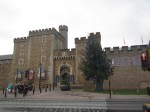
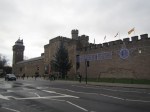
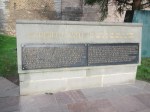
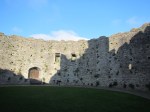
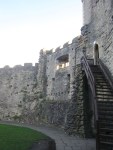
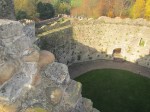
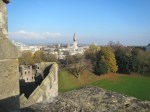
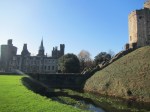
- Cardiff Castle–there was a Roman fort here in 55 AD, then it was rebuilt by the Normans in 1088, and expanded during their reign, then expanded during Victorian times by the Bute family
-
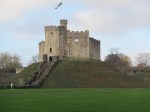
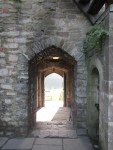
- The keep, very difficult to enter in the days of defense


-
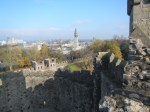
- The Civic Center complex from the top of the Castle
-
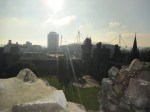
- The layers of history make up the skyline from the castle to the Millennium Stadium
-
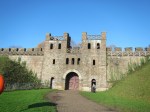
- The north gate, the stones at the bottom were laid by the Romans in 55 AD
-
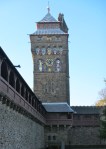
- The clock tower
-
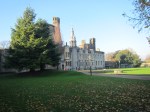
- The manor house at Cardiff Castle
-
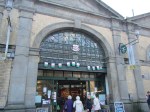
- The old city market survives
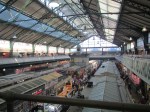
-

- inside the market
-
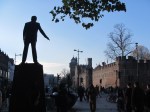
- Nye Bevan overlooks the castle
-
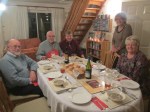
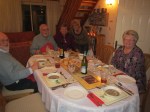
- The groaning board at Liz’: Gareth, Denzel, Roger, Liz, Pat
-
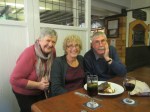
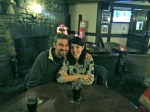
- Liz with her brother, Roger, and sister-in-law Ruth at The Bunch of Grapes
-
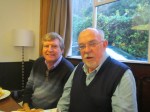
- Roger and Gareth at The Bunch of Grapes pub
 lettersfromatlantis