Oxford and More Family: Tales of the Trailing Spouse, Part VIII

We have just passed the halfway point of our British portion of Roger’s sabbatical. Suddenly, we both have the sense of the time flying by and the intensity of our schedule increasing tremendously. We realize that we are double-timing—trying to fit in all the university/consulting options for Rog and to see all the family and friends as well. So far, so great! But there are days when one or the other of us feels completely out of breath.

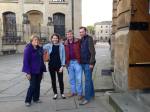
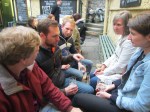
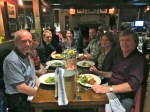
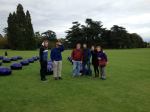
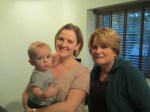
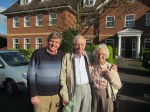
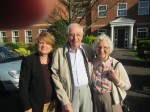
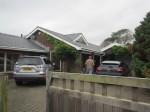
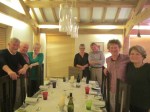
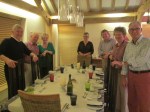
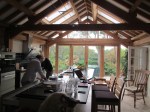
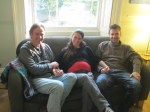
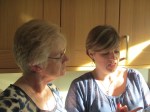
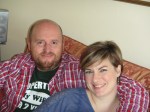
This past weekend was spent (well spent!) with our Simpson family relatives. Gillian, Roger’s little sister, is a teacher and this week is half-term holiday. So we joined her and her husband Dominic and her younger son, Matt (also a teacher on half-term) in visiting her older son, Ed, and his wife Claire in their new house just outside of Oxford.

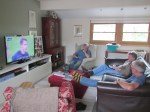
It was such a warm, comfortable visit, with the leisure to sit and talk for hours. I’ve never had the luxury of such long, in depth conversations with my nephews, now grown to be these wonderful young men, so full of ideas and exciting futures. It is a delight to get to know Claire better. She is one of a very few women engineers working on the aerodynamics of Formula-One cars, presently working for Mercedes Benz. The men watched both British football and American.

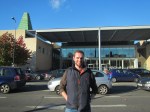
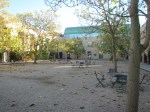
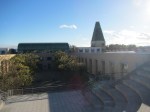
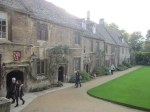
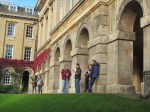
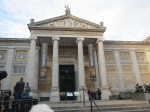
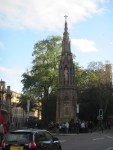
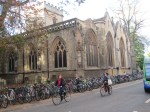
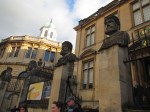
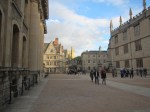
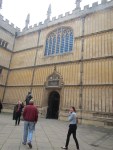
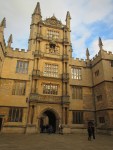
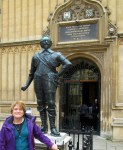
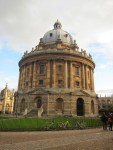
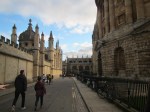
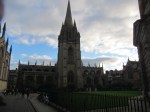
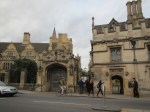
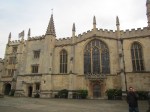
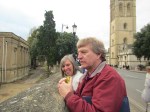
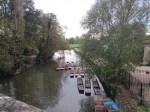
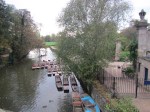
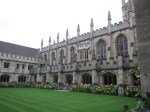
We wandered around Oxford to see Said Business School, where Edward works, and also the old beautiful colleges of the university. Said is especially interesting in a place like Oxford. The story is that Said, the donor, wanted to give mega-megabucks to Oxford to found a business school and they turned him down! It was felt that “business” wasn’t the right fit with Oxford’s esteemed intellectual identity. When at last Mr. Said’s munificence was accepted, they insisted that the school be built across the canal from the original colleges. I don’t know if this is an urban legend or at least partly true. I’ve heard it from several sources, so there might be some substance to it! At any rate, the school is hugely successful, very contemporary, and very impressive. It is so new that rooms still smell of new wood.

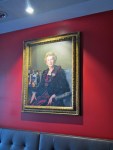
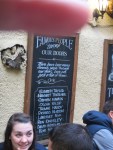
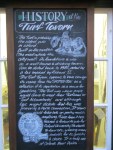
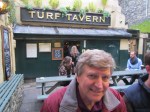
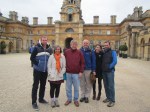
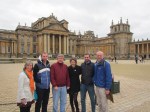
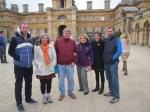
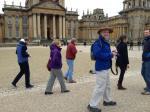
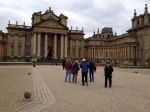
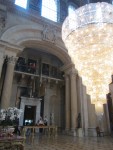
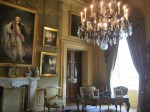
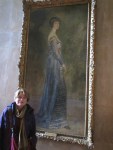
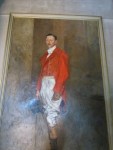
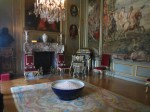
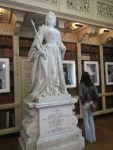
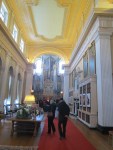
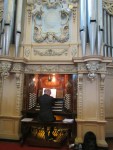
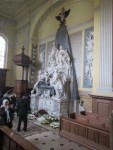
We wandered the town, in and out of buildings out of history and legend and went out to a great pub in the evening. Sunday we visited Blenheim Palace, the seat of the Spencer-Churchills, the Dukes of Marlborough. Blenheim was a reward to John Churchill for winning the Battle of Blenheim in 1704 and is one of the grandest palaces in England. The 11th Duke had died about 10 days before and our visit day was, fortunately, the first day that the palace had been reopened to the public after the funeral and mourning period. Blenheim, as all Newporters know, was restored in the late 1890s and at the turn of the 20th century, with the $10 million dowry of Consuelo Vanderbilt when she was married off to the 9th Duke of Marlborough in one of the biggest “cash for title” deals in Gilded Age history. It was not a happy match. But I enjoyed the three lovely portraits of Consuelo as the 9th Duchess that hang in the house.

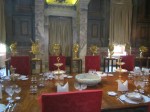
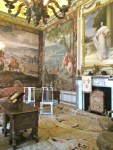
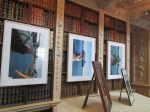
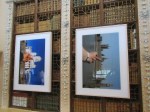
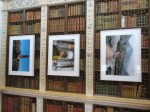
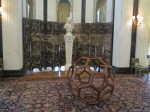
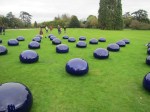
At the other end of the art scale, there was an exhibition of installations inside Blenheim by Ai Weiwei, the dissident Chinese artist. The exhibits were startling and certainly kept one’s attention. Sea crabs scuttled around in apartments elegantly furnished with 18th century chairs and portraits. Gilded beasts leered at the formal dining table settings. Photographs of every iconic site for global tourists were hung askew and punctuated down the center with a FU middle finger. It was all deeply, and obviously, subversive of everything Blenheim stood for—of the “meaning” of Blenheim Palace. What astounded me wasn’t the installations themselves—it was trying to figure out who on staff at this monster 18th century monument to power and aristocracy would give permission? invite? an artist like Weiwei to create tableaus that undercut the Blenheim experience in such an amazing way. We kept saying to each other: “Don’t they get it?”

We feasted that evening back at the house on the traditional roast beef and Yorkshire pudding, possibly the very best part of a great day.

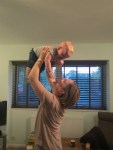
Our journey back took us the long way through London to Greenwich, and we were very glad we had Matt in the car with us to navigate! While he took off to his college to catch up on classroom work, we were able to see our niece Charlotte and her little son, Oscar, who comes up in a few days on his first birthday.

By the time we got back to Cranleigh, we were in need of laundry and sleep. But we are off again tomorrow . . .

Road Trip, Part II: Among these Dark Satanic Mills (Clitheroe and Manchester)

“Well, we’ve come this far. Might as well go the rest of the way.”

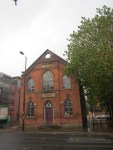
I am climbing up the steep stone steps to Clitheroe Castle, the highest point for many miles. It is pitch dark. It is pouring with rain. It is blowing a gale. This is an episode in this odd weather, where it will be clear for a while, mild and pleasant. Then suddenly a band of drenching rain will begin abruptly, blown in on a sharp blast of wind. Intense downpour for maybe 10 minutes, then it will stop and, once again, everything is fine and peaceful. When we started our climb, it wasn’t raining. By the time we arrive at the top, at the keep, the rain is blinding. But it is a triumphant and certainly interesting way to begin our stay in the market village of Clitheroe in Lancastershire where we are visiting Steve and Katherine. This castle is very old and is one of the smallest motte and bailey castles I’ve ever seen. But it was the seat of the Lords of Bowland until 1649. This was the first year of the Interregnum (right after they beheaded Charles I) and Parliament (in charge) went around putting potential anti-government defensive structures out of business. At Clitheroe Castle, they punched a huge hole right into the side of the keep,” to be put in such a condition that it might be neither a charge to the Commonwealth to keep it, nor a danger to be kept against them.”

Wet as we are, there is, fortunately, a warm, excellent restaurant close by that’s also on this evening’s agenda. Pico, the owner, always remembers Roger when he visits, and always gives Katherine and Steven special treatment.

Clitheroe is tiny, a very old market town in the Ribble Valley chartered in 1263, but older than that. Roger has been working with Steve for about 15 or 10 years supporting a revived British textile industry (think applications like medical supplies and aeronautics) and they had a very full week ahead.

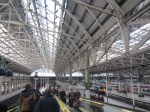
I took myself off by train to explore Manchester.

Manchester was a challenge to me. I had been under the assumption that this industrial giant of the late 19th century was a derelict Rust Belt kind of city, dirty, drab, impoverished. Nothing could be further from the truth. I realize that I was carrying around a load of assumptions about northern English cities based on some clichés of the 1970s and ‘80s. (American inner cities weren’t doing so great in those days either). I was disabused of these wrong-headed notions by a development colleague at Sussex University with whom I spent some time a few weeks ago. She urged me to visit it while I was in the area.

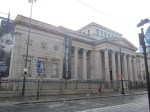
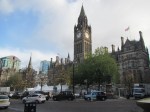
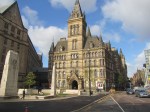
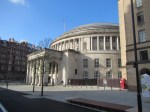
So, braving high winds and intermittent downpours, I gave myself a speedy one-day tour of Manchester (population just under 600,000): Manchester Art Gallery, Manchester Town Hall, Royal Exchange Theatre, Museum of Science and Industry, plus some long walks down elegant, prosperous shopping and business streets lined with a distinctive 19th century redbrick, neo-Gothic architecture and punctuated with very modern skyscrapers. There is an energy there, and a sophistication. It doesn’t feel like a regional town or some poor relation of London.

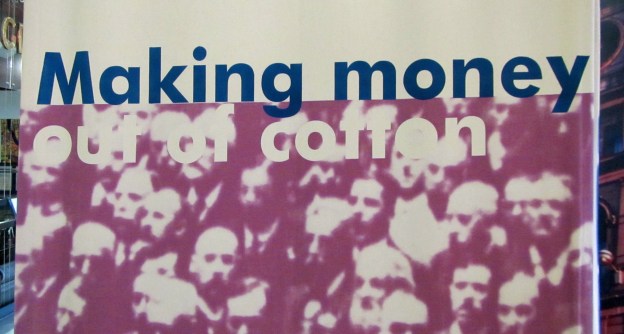
Manchester was ground zero of the Industrial Revolution. Everything modern happened here first. Not only the first and (eventually mightiest) textile mills and all the innovations to that industry from the mid-18th century on, but all the accompanying infrastructure was invented here: the first passenger train, the idea of warehouses, the expansion into heavy machinery and chemicals. The industrialists dug canals all the way to the coast (36 miles!) to bring in coal and to ship out their goods. Even today they are expanding these canals. Manchester was once the third largest container port in Britain despite being 40 miles inland.

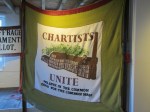
The city has a reputation for being radical. As the first truly industrialized city in the world, they were first to grapple with enormous extremes of wealth, an exploding population, slums, industrial pollution, sanitation issues, etc. The industrialists of Manchester were monster capitalists, but that very reservoir of wealth also produces its own backlash. There were bread riots, labor riots, the Peterborough Massacre of 1819, and the first Trades Union Congress. Fredrich Engles wrote The Condition of the Working Class in England in 1844 about Manchester, and Marx and Engels started writing the Communist Manifesto here in the world’s oldest public library (Chethams’s 1653). Woman suffrage was born here (the Pankhursts were local gals)! It was the cradle of the Labour Party. There were schools and universities founded by religious Dissenters (Quakers, Unitarians). As you might expect, they fostered technology and invention, so the sciences absolutely flourished in Manchester: the atom was first split here, the electron microscope was pioneered here, and the first stored-program computer was created here. Today, apparently, there’s a disproportionate LGBT population, so radical liberalism continues. What was interesting to me—granted, on only a few hours acquaintance—was the sense that the city’s identity derived from technological achievement (and the wealth from that) not, as often the case elsewhere in Britain, from the old hierarchy of landed aristocracy. This isn’t a new observation, of course, but it was a palpable feeling for me. I decided that I need to reread Elizabeth Gaskell’s novels.

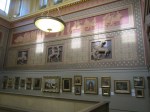
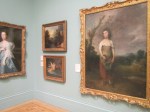
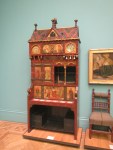
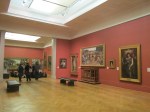
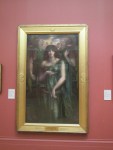
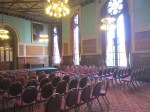
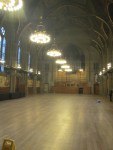
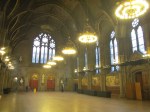
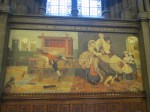
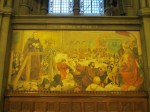
When I go to a city that had a heyday of huge wealth and industry, I like to visit the art museum to see what the local rich people were collecting at that time. It tells you a lot (I think) about their aspirations at that moment. (Think of the Met in New York and all those Old Masters from personal collections, of Chicago and all those Impressionists in the Art Institute.) So in Manchester’s smallish, but quite fine, Art Gallery the largest part of the collection is Pre-Raphaelite! These were, of course, the most radical painters of the mid-19th century in England. They thought of themselves as revolutionary and, interestingly, as taking a stand against all the mechanization and conventionality of the modern (that is, 19th century) world—everything that Manchester stood for. The Pre-Raphaelite Brotherhood were for medieval art, romantic realism and the detail of Nature, ancient English legends, objects and furniture that were handmade and craft-produced. Just a complete backlash against the factory culture that was producing all the money of Manchester (which was, among other things, buying art). I was tickled to find that the wonderful sequence of a dozen big murals in the Great Hall of the Manchester Town Hall (depicting the history of Manchester) were all done by Ford Madox Brown, who was Dante Gabriel Rosetti’s teacher and friend, a PRB precursor and a founding member of William Morris’ design company. There are some satirical elements in several of them—like the one about John Kay inventing the flying shuttle (which revolutionized weaving) has a crowd of rioting Luddites crashing through the window while Kay is being spirited out the back door wrapped in a blanket.

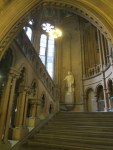
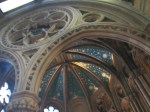
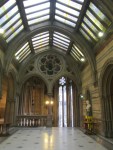
I got in to see those murals and the rest of the visitor-restricted part of Town Hall by coming on politely with wide-eyed enthusiasm and my American accent. I find this often works. So I was able to roam the mayor’s parlor, the committee rooms, the Great Hall, the grand staircase, etc. under a legitimate visitor’s pass. Manchester Town Hall is a very grand Gothic Revival complex from 1877. It’s all very elaborate late Victorian and ceremonial, but the statues and paintings all celebrate local scientists and this technological history I’ve been talking about.

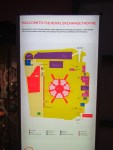
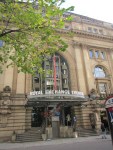
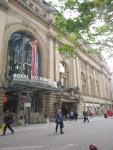
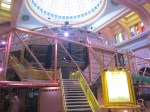
Most fascinating stop of the day was the Royal Exchange building. It’s the third exchange built since 1729, because trade grew at such a rate that they kept having to build bigger. This one, which opened for trade in 1874, was at that time the largest trading hall in the world and one of the largest rooms in the world, too. It’s this neo-classical shrine, a marble temple to money, very grand and gorgeous. The exchange took a direct hit in the Blitz and limped along until it closed for good in 1968. It was scheduled to be razed when a bunch of theatre folks took it on, founding the Royal Exchange Theatre and rescuing the historic space. The first Artistic Directors were Michael Elliott, Caspar Wrede, Richard Negri, James Maxwell, and Braham Murray. Lawrence Olivier opened the house in 1976.

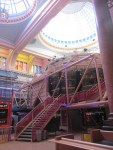
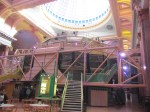
If ever there was a fabulous and emotional pitch to be made for all of us Rhode Islanders voting this November for Proposition 5 to help subsidize the restoration of our arts and performance spaces, a visit to this theatre is definitely IT. It’s a mind-blowing adaptive reuse. The house and in-the-round stage itself sits like a space craft that’s landed in the middle of the vast neo-classical room. Actually the floor of the old building can’t bear the weight of the theatre, so everything but the actual stage is suspended from the huge columns carrying the central dome of the building. There’s a 700-seat capacity possible on 3 levels—the largest in-the-round in Britain. They’ve also developed a 90-seat flexible black box in an antechamber. The Royal Exchange Theatre presents nine full productions a year, plus a holiday show, folk, jazz, and rock concerts, literary events, and a full roster of kids’ stuff. When I visited they were breaking down an all-female Hamlet and doing tech for Cat on a Hot Tin Roof. In 1996 the Exchange building was one of those severely damaged by an IRA bomb, just as they were about to open Stanley Houghton’s Hindle Wakes. Two years later, after refurbishment and an opening by Prince Edward, they opened with that play.

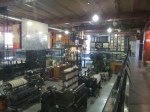
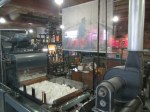
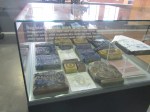
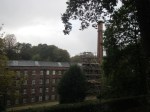
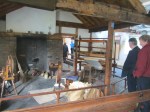
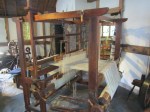
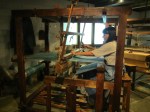
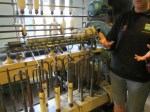
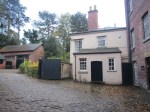
My afternoon was capped by meeting up with Roger and Steve after their successful mini-conference. Steve drove us out to Quarry Bank at Styal, a preserved and interpreted textile mill run by the National Trust. Established by Samuel Greg in 1784, QB was one of the earliest mills and ran right up to 1959. Like our Slater Mill (and you know that Sam Slater started by copying Arkwright plans from Manchester, bringing them to Pawtucket with Brown financing in 1790), there are well-informed interpreters who run and demonstrate the massive machinery and good exhibitions explaining the long, complex economic and social history. We had our own expert interpreter in Steve, who began his career in textiles as a certified weaver and could clearly explain all sorts of little facets of how these machines had evolved and worked. High winds had forced early closings to several buildings in the mill complex—but this may have been a good thing. There was so much to see, we’d still be there.

Road Trip, Part I: Kiss Away Each Hour of Herith (Swansea, Wales)

And so we’re off and, although we’ll touch base in Surrey at regular intervals, we’ll be moving around now for weeks. Our first stop is personal.

Following Russel and Christine’s car, we drive up the motorway to Wales, as we’ve done for so many years. But we’re going further than usual, to the west coast to Swansea on the kind invitation of an old friend and his wife. Andrew has been Russel’s best friend since they were boys of 8. They are godparents to one another’s children and regular companions in adventure for these many years. Roger knew Andrew well as a boy. They played on many teams together and Andrew was at our wedding (indeed, he was the designated driver for Rog’s bachelor night!). But Roger has lived abroad for 45 years. He remarked to Andrew when they were together that he had seen him at Russ and Chris’s wedding and the next time was when their daughter was married. In between, Andrew had had an entire career, a long marriage, two children and a grandson! We promise that it won’t be so long again.

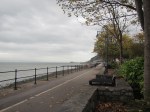
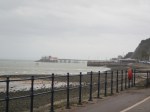
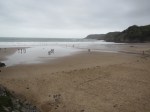
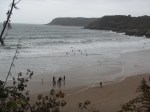
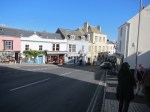
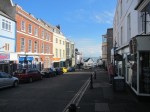
Swansea is on the southwest coast of Wales, right at the easternmost beginning of the Gower Peninsula. I recall this as a wild, beautiful, beachy stretch of coast. Swansea was the birthplace and home of Dylan Thomas, the great Welsh lyric poet, and also the original hometown of my father-in-law, Ron Warburton. We didn’t visit either of those birthplaces, but hung out way up on the Caswell cliffside neighborhoods next to the village of Mumbles. The bay it fronts is Mumbles Bay, a broad tidal bay with extreme tides that is part of the larger Swansea Bay. The other name associated with the area is Oystermouth, which I think is an old parish name. Like Lyme Regis, Mumbles is a very steep town with streets pouring down to the seafront. Now a tourist resort, the old fishermen’s houses are today nice restaurants and toney shops (of which we availed ourselves).
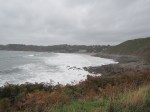
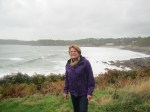
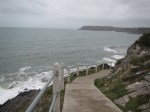
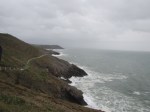
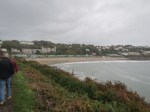
Little enough to elaborate on when remembering the non-stop good cheer of Gill’s elegant home-cooked meals, great conversation, and friends and more new friends. On Saturday, however, we hiked a section of the Welsh Coastal Path, a national walking path that now stretches the entire coast of Wales, 870 miles. The wind was high—a preview of the days ahead—and the surf was wild. Wet-suited surfers were out in force. In our three-something hours, we only went a few miles, from Caswell Bay over the cliffs to the headlands, down into Langland Bay, and back around the gorgeous golf course that backs up to their neighborhood. Some of the greens are on steep hillsides where most golf balls are in severe jeopardy.

By Sunday noon, though, we were back on the road to the north.

Dining with the Worshipful Company of Fuellers: Tales of the Trailing Spouse, Part V

Remember how in high school history class or in some English history class in college we learned about the guilds of the middle ages? You know, how the merchants and tradesmen of the growing cities gathered into associations where they regulated their industry, trained their apprentices, guaranteed the quality of what they manufactured, fixed prices, and excluded independent operators? You know, like the Bakers’ Guild, the Goldsmiths’ Guild, the Drapers’ Guild, or the Vinters Guild? These guilds came into England after the Norman Conquest (1066) and grew into a system called mercantilism. Guilds and their members became active, even dominant, in civic life and local politics. It was the guilds that sponsored the mystery plays of the middle ages. Chaucer mentions guild masters in The Canterbury Tales. They are this major feature of the rise of capitalism, too.

So, what happened to them? I bet you thought they disappeared. Not so, at least not in London.

The guilds, some of which go back to the 1100s, morphed and evolved into the livery companies of the City of London, of which there are 110 still operating today. Almost all of them are named “The Worshipful Company of . . .” and then the title of the trade, craft, or profession. Today they are elective fellowships that are charities and educational institutions as well as serious professional networking organizations. Nonetheless, they still revel in the ancient courtly traditions that stretch back centuries, observe their own peculiar protocols, and enact the grand and the majestic as only the British can do. A member, first beginning as a “freeman” who then becomes a “liveryman,” has certain ancient privileges. Some are funny today. For example, if sentenced to hang, a freeman is allowed a noose made of a silk rope. Freemen can drive sheep across London Bridge without paying a tax. But the liverymen also elect the Lord Mayor of London and have other official responsibilities in the City and to London.   http://www.cityoflondon.gov.uk/about-the-city/working-with-and-for-others/Pages/city-livery-companies.aspx

Each one of the original guilds had a guildhall that, since the guilds became extremely rich, were fabulously, elegantly decorated. Most of them were destroyed in the Great Fire of 1666. Most of those that survived or were rebuilt were hit during the Blitz of World War II. And yet, there are survivors, most dating to the early 1700s and still reflecting the glories and wealth of those guild associations.

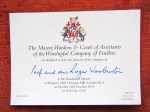
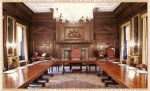
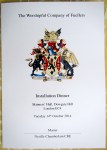
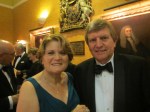
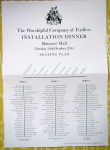
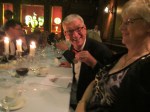
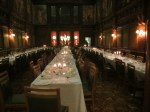
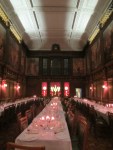
Last night Roger and I were honored and keenly delighted to be guests at the Installation Dinner of the Worshipful Company of Fuellers, held in gorgeous Skinner Hall (the Guildhall of the Worshipful Company of Skinners, rebuilt in 1670 after the Fire). http://www.skinnershall.com/welcome.html

Roger’s brother, Russel, is a Fueller. Indeed, he is a Court Assistant, meaning he’s on what’s like a Board of Directors. http://www.fuellers.co.uk The Fuellers trace their roots back to 1376 or earlier to the Coal Sellers, the association that later would handle the coal taxes that financed the rebuilding of the City of London after the Great Fire. So today their interests are across the board throughout the energy industries from coal and gas to renewable, green resources. They have a charitable trust fund, sponsor a school, do scholarships and lectures, support an air ambulance, and have affiliations with the Air Force and the Navy.

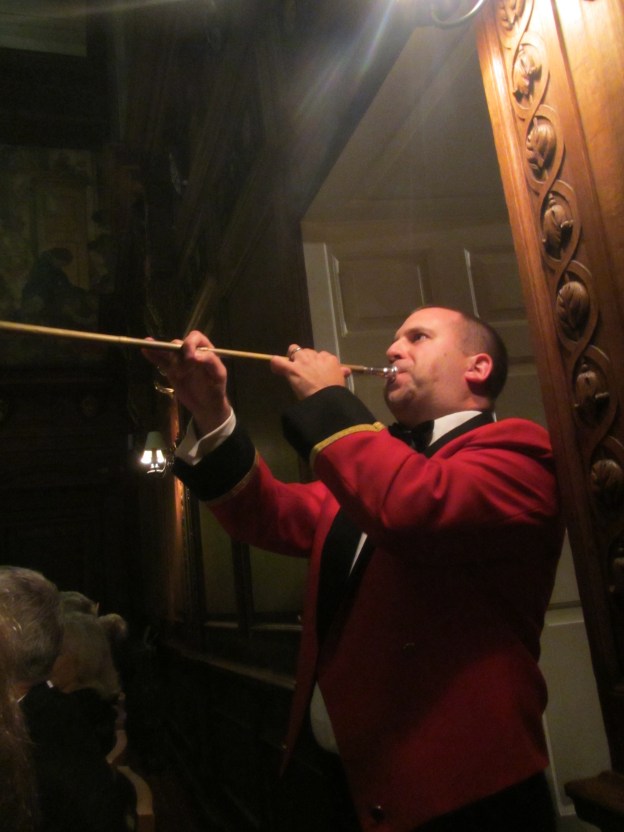
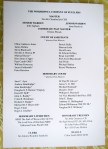
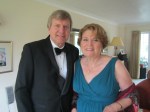
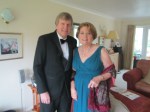
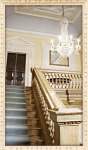
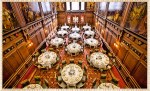
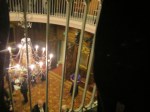
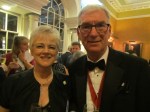
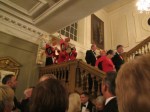
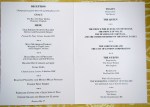
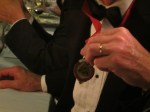
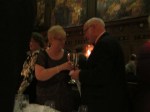
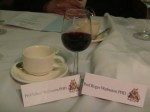
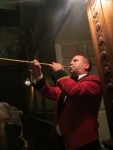
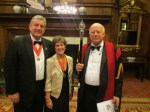
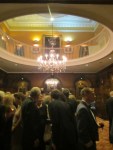
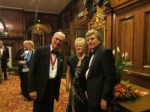
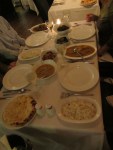
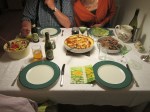
But, when they throw a banquet, it is all about the party! The Installation is the occasion when the new Master takes up his position. Men turned out in tuxes, swagged with ribbons and medals, women in gowns and jewelry. The Master and Wardens were gowned and hatted. In stentorian tones, we were announced for the receiving line by a gowned Beadle. We were summoned to dinner by a quartet of heralds playing post horns. Later, they played a show-off horn competition that was amazing! The four course delicious dinner was served in a sumptuous dining hall paneled with walnut and gleaming with candlelight and silver. An orchestra played from the hidden balcony (Hmmm. Do you think they’re playing “Home on the Range” for us?). There were some mercifully short speeches and many toasts. We toasted the Queen, the Royal Family, the Lord Mayor of London, the Distinguished Guests, and goodness-knows-who-else. There was even a Loving Cup toast with old traditions that was passed guest to guest around the hall.

Think, 150 people acting out Downton Abbey! One has to do it at least once.

Belmont and Lyme Regis: Tales of the Trailing Spouse, Part IV

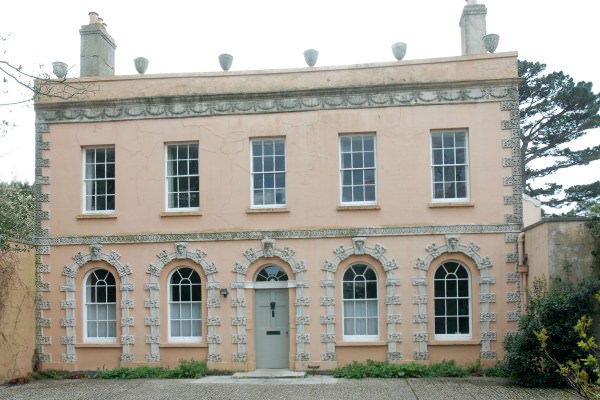
Belmont as I first saw it

Belmont as I first saw it

The first time I stood in front of this façade I was 26 years old. It was 1974. I was terrified. I had written John Fowles to ask if I might visit him and interview him and he had accepted—if I would agree not to stay “too long.” I had Roger with me (to drive and support me) and we had walked around Lyme Regis in the rain for an hour. We were both soaked—a couple of wet, bedraggled kids knocking on the very formidable front door of Belmont, home of the famous, best-selling author and his wife. Scared almost speechless.

That door opened onto people and events that changed my life, of course. I have described this before—how welcoming, kind, and sort of parental both John and Elizabeth were that day, and in many so days that were to happen in the future. I was one of the earliest of Fowles’ scholars and one that he liked and was glad to work with—I don’t know how that happened, but it’s true. Liz must have decided we were ok. She kept us there all the afternoon that day and was forever trying to get me to meet her daughter. Anyway, 30 years later, I was the one John chose to write his biography. I always thought it was partly because Liz liked me and, after her death, he wanted someone who would do right by her.

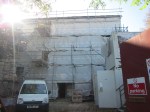
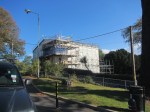
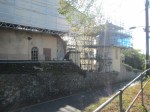
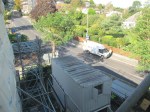
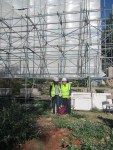
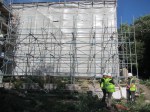
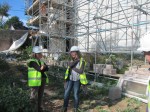
So, Friday, October 10th—with Liz’s daughter Anna, my dear friend for 20 years—I stood again in front of Belmont’s dramatic façade, now scaffolded, shrouded, and wrapped, a huge shiny box sitting on the top of Lyme’s hill, visible from all over. The day was blessed with the most glorious sunshine. We were about to be conducted on a tour of the construction of the historic preservation of Belmont by the Landmark Trust. We said later how fabulous it was that we were invited to see everything and understand what was going on, because if we had simply seen that monster and the surrounding construction site, we both would have felt so sad and depressed. As it turned out, however, we saw a Belmont beginning to come alive again—and we came away elated.

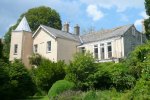
The Fowleses moved to Belmont in 1968, just after he had sent the manuscript of The French Lieutenant’s Woman to his publisher. He lived there until his death in 2005. Liz died there in 1990. John remarried ten years later to his friend Sarah Smith. It was Sarah who negotiated the sale of Belmont to the Landmark Trust, according to John’s wishes, so that the house would be saved and not turned into just another Lyme Regis hotel or restaurant. John was always proud of Belmont’s special history and felt it should be somehow shared with the nation. Belmont (which was built, I think, mid-18th century) was the summer villa of Eleanor Coade. Mrs. Coade was this extraordinary woman entrepreneur who created a formula for a manufactured stone to use in monuments, tombstones, and all kinds of decorations. This “stone” is tougher than real stone, withstands frost, and keeps intricate detail when other materials have weathered. It looks exactly like a fine marble or plaster. Major sculptures and monuments all over Britain are made from it. In her day, Eleanor had a virtual monopoly on it and the formula was secret. She became very wealthy. She moved to Belmont in the seaside resort of Lyme Regis in 1874 and turned it into a showplace for her elegant Coadestone decoration which is embedded into the house everywhere. After she died, the house was occupied by various Victorians who built on wings (some very ugly), landscaped terraces, and even built a working observatory tower. John and Elizabeth made no structural changes—all his domestic energy, I think, went into the garden.

So the Landmark Trust took on the house mostly for the Eleanor Coade association, with some attention (and real gratitude) to Fowles. While they were raising the money to start reconstruction, their architectural historians came up with a plan to return Belmont to its 18th century original by removing the Victorian wings, restoring fireplaces and windows, and recreating the shapes and sizes of the original rooms. This meant, for one thing, demolishing the section of the building that housed the large rear sitting room used by the Fowles and their bedroom. This caused quite a stir of controversy. Sarah Fowles gave interviews in the press, calling Belmont “a dump,” and accusing the Landmark Trust of hypocrisy.

Anna and I felt that actually John and Liz Fowles would have approved of the restoration idea, but we had to see it for ourselves. Things change, we agreed, but there was new life here.

Here’s the link: there’s great information here. http://www.landmarktrust.org.uk/belmont/

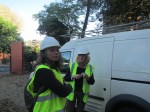
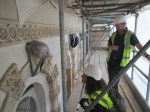
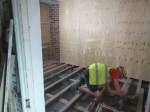
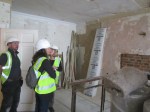
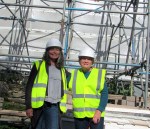
Carol Paton, the project surveyor, met us inside the gates and took us into the site office to sign in and pick up hard hats and green construction vests. We were introduced to the visiting building inspector—“John Fowles’ step-daughter, John Fowles’ biographer”—and he raised his eyebrows and murmured, “Well. THAT is interesting.” With Stuart Leavy, the Belmont site manager, Carol took us into the building, beginning with climbing the scaffolding up to the rooftops.

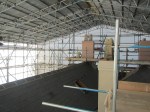
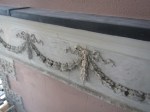
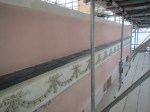
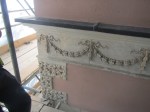
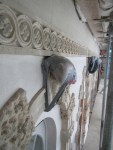
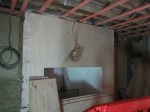
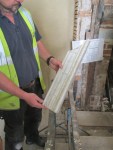
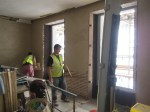
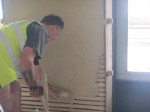
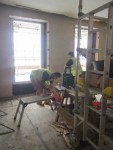
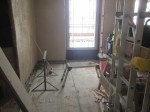
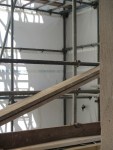
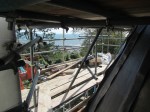
I have to say that the warmth of their welcome and their enthusiasm and respect for the project went a long way in making our day so wonderful. Carol and Stuart spent two leisurely hours poking into everything with us. They said several times how great it was that we were there at that time because the scaffolding allowed us to go all over the building. In a month, the scaffolds will come down, the house will be buttoned up, and they will be closing the walls and windows. We have seen the heartbeat of the house, open walls, chimneys being rebuilt, odd Victorian built-ons removed, spaces opened up, windows put back in ghost frames. On the scaffolding we were able to get a very close view, even to touch, the Coade Stone frieze at the top of the house and the faces of Neptune and Amphitrite embedded over the door and windows. We saw the repairs to the settling of the house, the steel beams reinforcing the floors, the hidden solar panels disguised with the Welsh slate on the roof. I peeked through the window into “my” bedroom and Anna into hers.

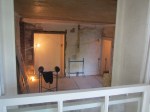
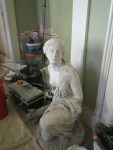
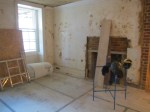
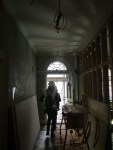
Inside several of the rooms have been divided, restoring their 18th century dimensions. Anna could walk through, placing furniture in imagination for Carol and Stuart, talking about decoration, wallpapers, the use of each room. We each had our own memories, of course. ‘Here,’ I would think, ‘I met Katharine, Kevin, Jim, Kirki, Diane. . .all the Fowles scholars who came.’ ‘Here is John, pouring coffee into my cup, agreeing that, yes, I should be his biographer.’ ‘Here is Liz, bending down to get to eye level with my 5-year old.’ Sometimes one or the other of us would go emotional and quiet and only by a hand clutched on an arm would anyone know. When we came upon the little statue of Demeter who had blessed John’s garden, we simultaneously burst out with excitement (to the crew’s real delight) because we had been wondering just that morning what had become of her. She seemed a sign of good there.

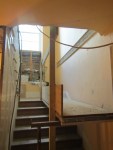
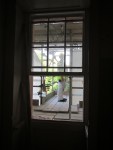
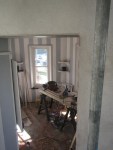
We had worried, what would we feel each with the sitting room gone and that upstairs back bedroom gone? But that was the strangest part. The “new” (or newly configured) rooms felt so much like that was the way they “should” be. Not only were they both snug but roomy, but they were filled with light in a way that Belmont had not been. Alcoves were opened up, fireplaces revealed, odd walls gone, windows revealed. There was—even in the mess of construction—an 18th century grace to the rooms. Where the old bedroom had been—sunlight and a direct, shimmering view of the sea. The proportions now were right and the whole house felt like it was waking up.

John’s writing room is being restored to its original use as the principle sitting room in the house. But some of his display cases and books will be returned to view and visitors will be able to access the history of his time in the house. It was always the best room in the house and, with those windows looking out on the sea and the newly-restored friezes of Coade Stone, it still will be.

Anna was convinced that her mother would have loved the results, would have loved to have lived in some of those rooms. I worked with John on some historical projects for the museum and I genuinely feel he would have been fascinated and proud.

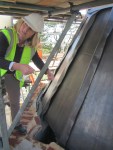
We were even allowed to climb the scaffolding surrounding the observatory tower, which is now standing free of the house. We squeezed our way up the ladders and through hatches to get all the way to the copper-plated turret. What a view! One of the great moments of the project for the whole crew was when they removed wedged-in stones from the base of the turret and found that the 19th century mechanism still worked and the turret turned and opened for a telescope! John Fowles would have been so excited! He used to sigh and shake his head, saying, alas, the turret no longer worked.

The back lawn (badminton? strawberry teas?) is currently a wreck, a construction site. But the topsoil is piled into a mountain, waiting to be returned and re-landscaped. The view of the English Channel and the Cobb is open. The magic of the place is coming back.

Anna and I left to walk down the steep hill into Lyme Regis to the harbor. Lyme hasn’t changed much. We were exhilarated, talking over each other, making no sense. The Landmark Trust people will be wanting to talk with her again, I am sure.

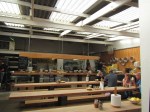
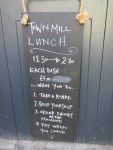
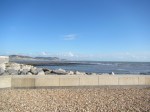
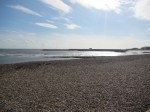
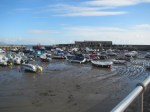
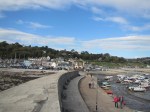
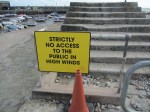
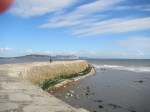
After lunch at the town mill bakery, we decided to walk along the sea front while the sun still shone so gloriously. We passed along the beach and boardwalk and came to the Cobb. At the entrance stood a yellow sign warning people not to go up onto it because of the stiff wind. We ignored it. I said, “Imagine. If that sign had been observed in the 1960s, there would have been no Sarah Woodruff in John’s mind and no French Lieutenant’s Woman. We would never have met!”

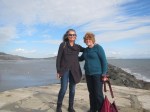
We walked up along the top of the Cobb, hanging onto each other. Because the wind WAS high. As we came to the end, we agreed that we should take the obvious photos—the Poor Tragedy at the end of the Cobb picture—because who knew if we would ever have the chance again? So, there was a couple taking pictures of each other. I walked up and asked, would they like me to take them both together? They were delighted. Afterwards I asked, would they be kind enough to take a few of my friend and me at the end of the Cobb?

“Oh,” the woman smiled knowingly, “Have you seen that wonderful film? The French Lieutenant’s Woman? Have you seen it?”

We smiled blandly. “Yes.” We replied. “A few times.”

Bristol: Tales of the Trailing Spouse, Part III

“So, how do you know Anna?”

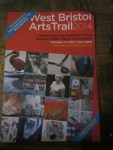
I am standing, drink in hand, in the living room of my friends Anna and Charles. It’s their private preview evening for the West Bristol Arts Trail, a gallery walk event that tours people through the private homes and studios of artists throughout Bristol. Anna is a painter and Charles makes custom, hand-crafted furniture. I love staying in their house. Everywhere one turns there are little found objects and images, set out for a beauty that someone else may never have noticed. Polished stones, lovely baskets, a strip of cloth, a postcard, a split piece of wood with gorgeous texture and grain. Colors that I could never attempt. Flowers and fruit picking up colors in the wood floor, a door lintel, as well as paintings. Anna’s paintings and prints. Charles’ furniture and wood shop. I always find myself stopping to touch or contemplate.

At the moment, their high terraced 18th century house looking over the city towards the river looks like a gallery. We have shifted furniture, stowed domestic items away, changed light bulbs, laid out canapés and wine glasses. Anna’s paintings are everywhere. Charles’ tables, stools, and chairs line the hall and kitchen. The weather cooperated and the house is full of friends for their opening.

The question “So-how-do-you-know-Anna?” is a casual, cocktail party opening, perhaps provoked by my American accent. My response surprises a bit: “Well, it’s a little bizarre.” For Anna is the step-daughter of John Fowles, the great 20th century British novelist who died in 2005. I am his biographer. Twenty years ago, we two found ourselves tangled together with the man, the biography project, and the weaving of my story about Fowles, which was also the story of her life, her mother’s, even her children’s. All pretty complicated, if I think about it. Somewhere along the way, the friendship outgrew the situation. Was that at the kitchen table of John’s house in Lyme Regis? Or was it climbing the hill leading up to the Acropolis in Athens? Was it over children? We seem to have slipped into it.

My friendship with Charles I can pinpoint to July 4, 1996. There was a grand symposium of international scholars in Lyme Regis celebrating John Fowles. The house was full of scholarly guests and the dishwasher broke down. Charles and I appointed ourselves the dishwashing team for three days. We were champs. We still laugh about it.

For me, as I said, the friendship outgrew the Fowles connection long ago and our visits are much more about where we are now. This visit, however, Anna and I have agreed to return together to Lyme Regis and look over the restoration by the Landmark Trust of Belmont, Liz and John’s house. We anticipate an emotional visit and figure we can mutually support each other. We’ve viewed the Trust website with its videos of demolition and paint stripping and heavy machinery. And then we decided to ask for permission to come onto the construction site and look around.

I spend Thursday morning making phone calls and talking my way through the Trust offices until I’m granted the right phone number of the project supervisor on site at Belmont. I finally reach her and think, “Nothing ventured, nothing gained.” So, all brass and American accent, I introduce myself and Anna and ask to be allowed to come onto the site. Some wariness. I could tell she wondered if we were out to make trouble. There was some controversy about some decisions to bring the house back to its 18th century original, thereby changing the room layout of the Fowles’ residency. I outdid myself with effusive persuasion. At last, Carol (who turned out to be exceedingly welcoming and generous) said, “Well, I just must stress that you have to wear sensible shoes.” I assured her that, on Lyme’s steep hills and streets, I always wore walking shoes. We were accepted.

I walk into the kitchen and announced that Anna and I were to wear sensible shoes and meet the project supervisor at Belmont at noon Friday, October 10th. We hug in delighted disbelief.

Tales of the Trailing Spouse, Part II: Cranleigh

This morning we woke to frost. The lawn of my sister-in-law’s garden is silvered. The windows of the greenhouse are patterned with whorls of white. The heat in the house is on and true autumn has arrived. For the past two weeks (call it a fortnight) the south of England has enjoyed a beautifully warm and sunny Indian summer (a term borrowed from us). Everyone has worn tee-shirts and shorts at home and I’ve wondered when I would break out all the warmer clothes we packed.

So, I begin in England discussing the weather. This is right, since that’s what everyone does, to almost a comical degree if you’re not British yourself.

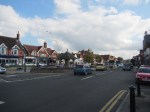
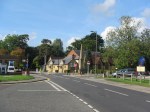
We are based at Cranleigh, a post-card pretty village in Surrey, where Roger’s brother and his wife live, their children (our niece and her husband, our nephew, his wife and his daughter) have come back to live, and in an area close to Roger’s parents and one of his sisters and her family. Without the great kindness of Russel and Christine to offer us this long stay in their house, we couldn’t have pulled off this sabbatical. As it is, everything is so comfortable and familiar.

I realized, walking around the village a day or two ago, that I’ve been coming here for almost 35 years and have never written about it. I suppose it doesn’t seem part of the touristy routine and I take it for granted. But Cranleigh is a bit special.

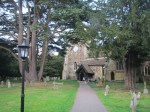
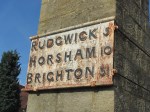
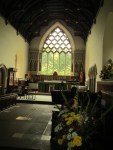
It’s an old village. There was settlement here at least as far back at 1086, the time of the Domesday Book, although it was part of Shere manor then. The church, St. Nicholas, goes back to 1170. The present classic Anglican building was built in the mid-1400s and extensively restored in 1847. In 1657 Oliver Cromwell quartered his troops in one of the buildings still on the High Street (now a restaurant with good food and slow service). The village is surrounded by countryside. Beautiful, patchwork fields and farms with horses and sheep, and the dense remnants of a very old forest called the Weald (the roads are very narrow and twisty). But it’s also close to towns like Guildford and Horsham, so it’s convenient to the railways and to London. All this makes it a very attractive bedroom community to the City as well as a stand-alone village. On the outskirts are estates of rock stars like Ringo Starr and Eric Clapton. There is, of course, a cricket club (1843) with well-kept pitch and a nice clubhouse. Roger celebrated his 50th birthday there (a few years ago!) partnering with his brother, and they won.
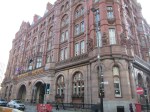
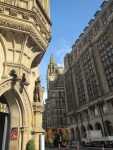
Cranleigh styles itself the largest village in England. Population a bit over 11,000, but the claim to size has more to do with the sprawl of neighborhoods that spread out from the central high street. The place has a strong sense of its own identity and hasn’t succumbed to big box stores and national chains. There is a Sainsburys and an M&S food, but there’s also a local fishmonger, an ironmonger, a good butcher, a nice bakery. Sadly, the bookstore has gone since my last long stay. There’s one of those small family department stores (remember Leys’?) that goes back to the late 1880s and has managed to keep up and survive. There’s always interesting stuff in Mann’s.

Roger, during this period of the sabbatical, has been commuting back and forth from Cranleigh to the University of Sussex in Brighton, a little over an hour away. He complains—isn’t that a Rhode Islander for you? Sussex is Rog’s undergraduate alma mater, so there’s a little nostalgia and pride mixed in with the business of meetings and talks he’s there for. I’ve been asked to talk with their development office on Tuesday about university fund-raising in America.

Staying here, we see family. We visit Roger’s parents in the village of Warnham. I get to meet up for coffee with my niece, Gemma, here is Cranleigh. Sunday Gemma and her husband Jon, and Roger’s sister Gillian and her husband Dominic all came for dinner with Russ, Chris, and us. Being able to combine his working sabbatical with a long visit to his family is exceptional for Rog—likewise myself.

Tales of the Trailing Spouse, Part I: Denmark

My friend Dorthe and I are chatting away, strolling through the pedestrian shopping district of central Aarhus, Denmark on our way to a restaurant for dinner. Roger and Erland are walking together well ahead of us on the street, each leaning into the conversation, happily engrossed in what they’ve talked about for three days—the equations of their joint theory of supply chains or, alternatively, university politics. They are so obviously enjoying themselves, and I think, “This is what we’ve come for.”

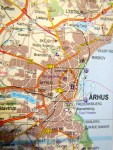
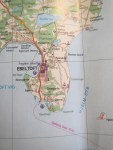
Aarhus, Denmark (correct spelling Arhus, with a little circle or band over the A) is our first stop on Roger’s sabbatical. Some years ago he was a conference participant in Salerno, Italy while I was, yes, the trailing spouse or, as they called it, “an accompanying person.” A delightful Danish lady was also in that category and while we queued in the broiling sun waiting for tour buses that were invariably an hour late, we buddied up and became friendly. Roger, meanwhile, connected with the only other conference participant who worked in the same kind of mathematical equations for supply chains and those two found themselves an empty room with a white board and spent happy, mad hours completing each other’s theories. Naturally, it turned out that the delightful Danish lady and the Danish professor who actually spoke the same language as Rog are a married couple. A friendship and working partnership was struck.

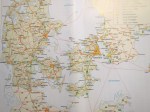
Aarhus is halfway up the eastern coast of Jutland, at about the same longitude as Edinburgh, Moscow, or Alberta. Settlement goes back over 1,000 years to at least 800. It is the second largest city in Denmark. It’s an immense container port, busy and prosperous. There’s a great building boom going on with massive glass and concrete modern office buildings and skyscrapers being erected near the harbor. Our friends disapprove. The traditional brick architecture of Aarhus is spacious enough and very traditionally attractive, with high windows and rooftop skylights. All buildings seem to want to let in more light. The sea is always nearby and the area is coastal, with only low, gently rolling hills relieving the beaches and flats. Very rural outside the city, lovely. The light this time of year is exquisite–long, clear, slanted sunlight illuminating the tilled fields, long white farmhouses, and forests of evergreen and birch. Late September is breezy and cool, but so crisp.

On our first afternoon our friends gave us a smorgasbord lunch at their house in the Risskov neighborhood, then we explored the beach right down their road on Aarhus Bay. In the distance we could see the cranes and ships of the harbor. By evening we four found our way to a French restaurant in an old section of Aarhus, in a tiny, gnarly building supposedly the oldest place in the city to house a restaurant. From the beginning, the conversation has been a feast in itself—politics, children, travel—but then books, films. And when am I just able to talk about language—how words work and change, the evolution, the structure, comparing and just figuring it all out? But Dorthe is a translator and for me this was a casual, constant thread through our weekend.

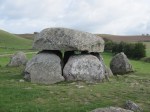
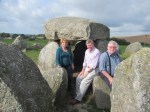
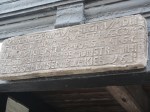
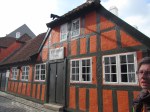
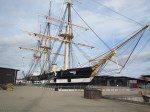
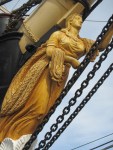
Our Sunday began with a trip out to Ebeltopf, a medieval town perched on the other side of the bay. We wound through the countryside, stopping to view a ruined castle on a coastal island. Then to the “Poskar Stenhaus,” a grave barrow estimated to be 5,000 years old. There are other barrows in the countryside, high anomalous hillocks that suddenly jut up from the landscape. But this is the last fully preserved “round barrow” in Denmark, a stone circle surrounding 4 upright megaliths and a capstone of 11.5 tons. Clearly, some extremely important stone age chieftain is buried there. After wandering Ebeltopf and having lunch, we toured the Jylland (which is Danish for Jutland), a frigate, the largest wooden ship in the world. And she is HUGE, 71 meters long with a 13 meter wide beam, a mighty and ferocious warship of the 19th century. She carried 44 cannon and a crew of 437. Today she is in dry dock, an interactive museum herself that we practically had to ourselves. Our day finished back in Risskov where Erland roasted lamb, Dorthe made a summer plum cake, and we continued the talk and eating and drinking.

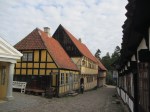
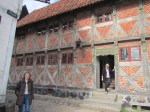
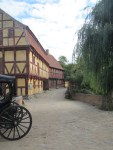
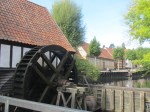
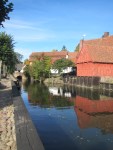
Monday was Roger’s day at Aarhus University, the Business School. He talked to faculty and dissertation students (apparently successfully), but the day was really about “drawing on the blackboard” with Erland, continuing their work and forgetting everything else. Dorthe and I spent a long, leisurely, excellent day at Den Gamle By (The Old City), a living history museum made up of a staggering collection of houses from all historical periods from c. 1700 to 1974, preserved and re-sited to this Aarhus park from all over Denmark. There are cobblestone streets and a millstream. Some houses are pure exhibition, some have costumed interpreters who stay in their historic period. But the most immersive part of the experience is that many period houses are so completely equipped and decorated and visitors can touch and handle objects and have the sense of being a little in the time. It was really well done. Even the restaurant food was traditional. It was most interesting to enter the 1960s and early 1970s—a time we both lived in and recalled sharply—because the environments were complete contexts. A bookshop from the late ‘60s where you could browse books, magazines, even comic books that were familiar from one’s own experience. A beauty salon, a grocery store with items and prices from that day. An extremely popular piece of history is the detail-perfect reproduction of a student commune from the early ‘70s. (Frankly, I found it too clean. I can’t imagine students in that time living so neatly!) But each apartment one entered was a completely immersive time capsule. You could open drawers and cupboards and handle personal effects. We gave ourselves the day—punctuated by pastries from the 18th century bakeshop that were baked to 18th century recipes and pancakes offered from the kitchen of the merchant’s house.

It was our last evening, spent having dinner in a famous “Barbeque” started by an Israeli immigrant 50 years ago and a hang-out for musicians and artists every since.

Sorry, my patient friends, that getting up a second blog has taken this long. We have been travelling. Now, however, we are based with Roger’s brother and our sister-in-law in Surrey (and have reliable wi-fi for a bit!).

Timid Beginnings

R&E Sussex NYC March 2014

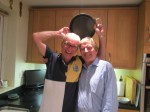
Greetings and welcome to my blog, Letters from Atlantis. My initial intention here is to stay in communication with friends and family while I travel with my husband during the months of Roger’s academic sabbatical. So, the opening chapters of the blog will be entitled “Tales of the Trailing Spouse.” I’ll chronicle where I am, who I’m with, and what I think of it all. There will be photos, too. You—the folks I’m comfortable talking to—can check up on what we’re doing. Or you can ignore it.

You may find that it takes me some weeks to figure out the formatting and editing. Plus, I have no idea if any of it will be interesting.

The idea is growing on me, however, that there’s the potential for more than a travel log in this blogging business. So Letters from Atlantis may become an outlet for personal reflections and memoirs. Or not. I’ll have to see how it goes. . .

For now, dear friends, you are invited to join me on my journey.